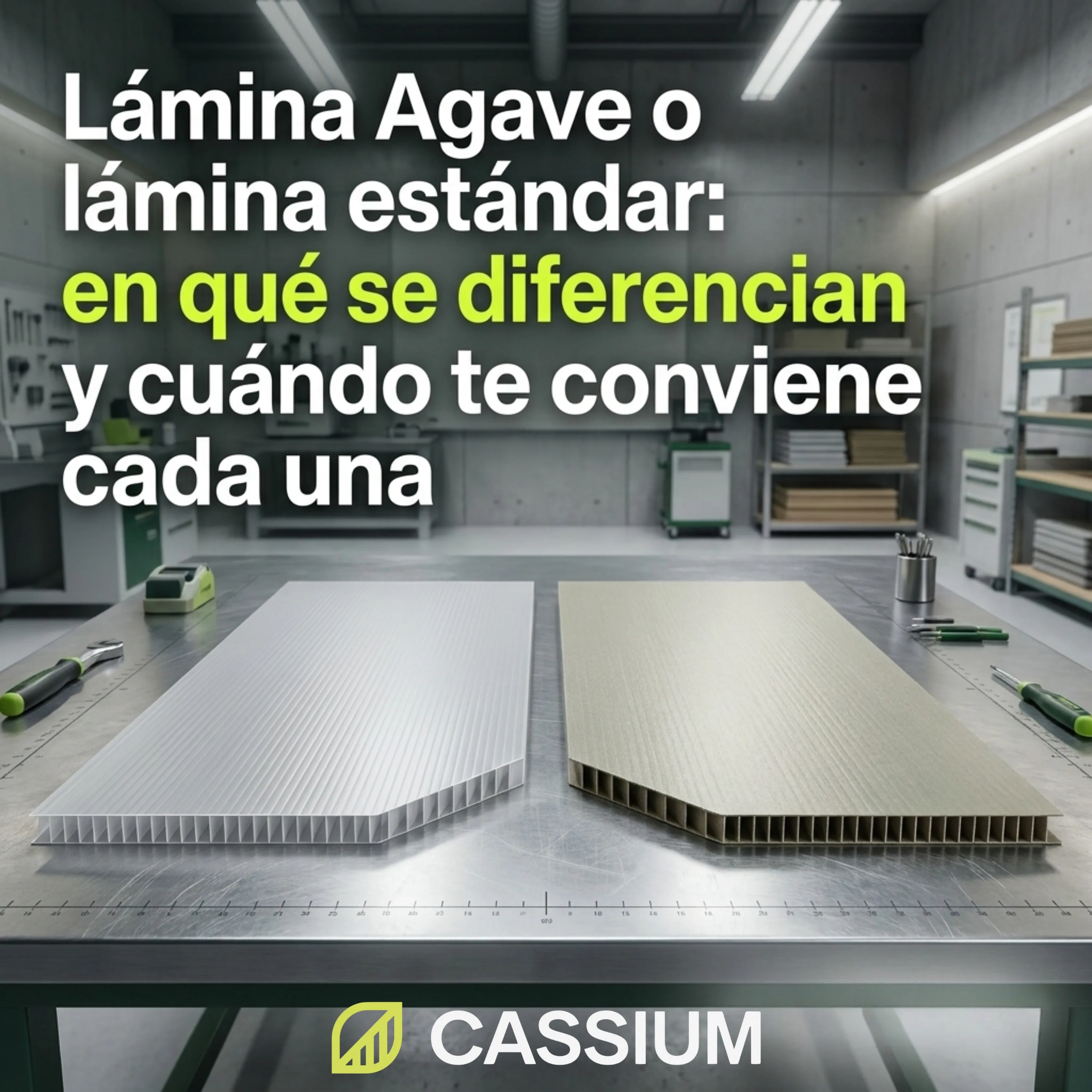
The Risk of Ordering the Wrong Sheet When You Don't Know the Difference Between Standard and Agave
What Really Sets the Agave Finish Apart From the Standard Smooth Finish
Cassium's Standard sheet has a smooth surface that offers the best base for direct printing and for applications where the packaging's function is structural, not visual. It's used by operations that need separators, returnable containers, or protective panels where what matters is the material's strength.
Agave sheet incorporates a textured finish on its surface. That texture hides scratches and handling marks that would show up on a smooth surface, improves grip when handling the piece, and gives it a different presentation when the packaging is visible to the consumer or end customer. Surface finish, not gauge or the polypropylene we manufacture the sheet from, is what sets one variant apart from the other, and what should guide your choice.
This distinction isn't clearly documented in most of the corrugated sheet catalogs on the market, which explains why many buyers reach their first quote without knowing the Agave variant exists. Explicitly asking about surface finish, before focusing only on gauge or color, is the first step to avoiding an incomplete specification.
When the Smooth Surface of Standard Sheet Is the Right Choice for Your Operation
Applications Where Structural Function Matters More Than Presentation
If your application is returnable packaging between production stations, load separators on racks, or part protection during internal transport, Standard sheet covers that function without you paying for a finish no one is going to see. In automotive, manufacturing, and logistics, where corrugated sheet circulates inside the plant or between suppliers and never reaches the end consumer's hands, the smooth surface is the option that best fits your per-piece cost.
The smooth surface is also the one that takes direct printing best when you need to mark product code, lot number, or handling instructions on the sheet itself. If your operation depends on that printed traceability, Standard sheet gives you the most consistent base for ink to adhere evenly.
In logistics and pharma, where traceability and packaging cleanliness take priority over visual presentation, Standard sheet's smooth surface also makes cleaning and disinfection processes easier between use cycles, because it doesn't trap residue in its texture the way a textured finish could.
When Agave Sheet's Texture Solves a Problem the Smooth Finish Doesn't
Presentation, Repeated Handling, and Applications Visible to the End Customer
When your packaging is exposed to the consumer, whether at the point of sale, on display stands, or in applications where the product's image matters as much as its protection, the Agave finish hides the natural wear of packaging that gets handled, transported, and reused multiple times. In food, beverage, and printing, where packaging presentation communicates something about the brand it protects, that finish difference carries commercial weight beyond the technical.
The texture also brings an operational benefit in applications with frequent manual handling. A finish that improves grip reduces the risk of the piece slipping during handling, something your logistics team notices especially on shifts where the handling pace is high and hands aren't always completely dry.
In construction and printing, where packaging often also functions as signage material or visible protection on site, the Agave finish holds up better against the worn appearance that daily field handling leaves behind, without losing the protective function you need.
Why Misspecifying the Variant Costs You More Than the Price of the Sheet
Gauge, Variant, and Spec Sheet: The Three Data Points to Confirm Before Quoting
Beyond choosing between Standard and Agave, your specification needs to confirm the right gauge, between 2 and 6 mm depending on your load's weight and handling, and whether your application needs any additional variant from the catalog, like UV sheet for prolonged outdoor exposure or ESD sheet for handling electronic components and batteries. Confusing the finish variant with gauge or with these specialized variants is the most common mistake that delays a quote.
We manufacture all our corrugated polypropylene sheet with our own extrusion at our Monterrey plant, under an ISO 9001:2015-certified quality management system. That control lets you confirm the exact variant you need, at the right gauge, without relying on different interpretations between your team and ours every time you place a new order.
What to Ask Your Supplier Before Closing the Spec If You Buy for Multiple Applications
A Clear Spec Sheet Keeps the Same Question From Coming Up on Every New Order
If your company buys corrugated sheet for more than one application, for example internal separators in manufacturing and visible packaging at the point of sale, you'll probably need both variants within the same order. Ask your supplier for a spec sheet that clearly documents the finish, the gauge, and the specialized variant, whether UV or ESD, for each application you've identified.
That clarity keeps the question you resolved in this quote from coming up again the next time a teammate places a new order. A specification documented once, with the right finish for each use, is what saves you time on every purchase cycle after the first one, not just on that first order.
How to Decide Between Standard and Agave Without Relying on Trial and Error on Your Next Order
Three Questions That Define the Right Variant Before You Quote
The first question you need to answer is whether your packaging will be exposed to a customer, an end consumer, or a visitor at the point of sale. If the answer is yes, Agave sheet's texture usually handles that exposure better than a smooth surface that shows every scratch from daily handling.
The second question is how much the piece will be handled by hand over its useful life. The more frequent manual handling your application has, the more value the extra grip from the textured finish adds, especially on long shifts or in operations where the same packaging passes through several hands before reaching its final destination.
The third question is whether your application depends on high-definition direct printing on the sheet itself. If you need barcodes, lot numbers, or detailed graphics printed directly on the surface, Standard sheet remains the most reliable base, even if the rest of your criteria point toward the textured finish.
Answering these three questions before you put together your quote keeps the choice between Standard and Agave from depending on trying one variant, finding out it doesn't work, and ordering the other in a second attempt that delays your project.