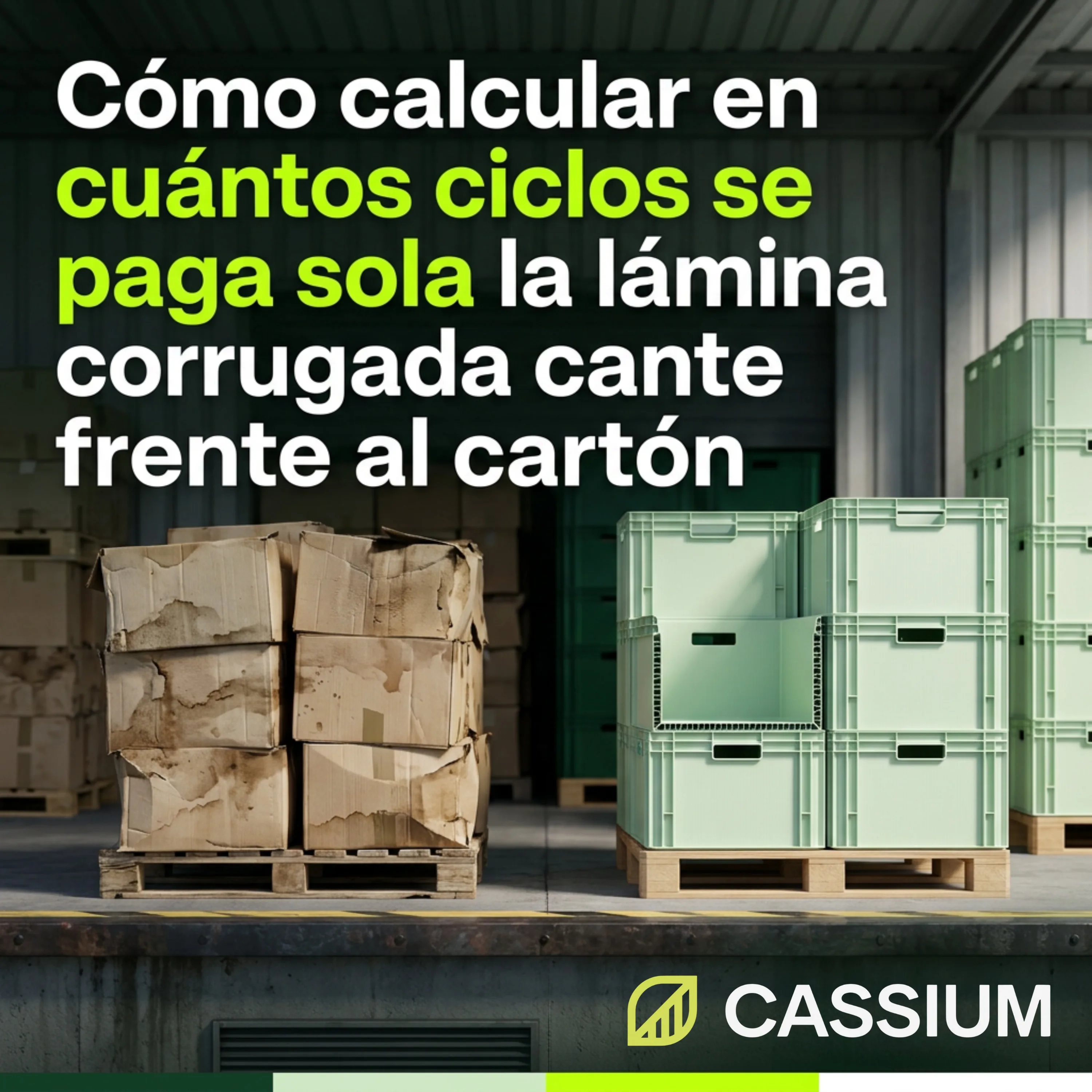
The Mistake of Justifying a Switch From Cardboard to Sheet on Piece Price Alone
When you compare corrugated cardboard to extruded polypropylene sheet purely on the cost of each piece, cardboard wins almost every time. It's an incomplete comparison, because cardboard is bought once and discarded after a single use, while corrugated sheet is designed to withstand multiple cycles of handling, transport, and storage without losing its structural function.
The result of that partial comparison is predictable. Leadership approves the cardboard purchase because the upfront number is lower, and your operation absorbs the real cost several months later, when it's your team managing the replacements, the waste, and the hours spent reassembling packaging that can't take another trip.
Why Piece Price Hides the Real Cost of Each Cycle
Cardboard's piece price responds to a single use event. As soon as that packaging gets damp on a loading dock, tears during forklift handling, or loses rigidity after stacking on warehouse racks, your team writes it off and buys a new one. In sectors like food, beverage, or pharma, where packaging faces moisture, refrigeration, or frequent cleaning processes, that replacement cycle speeds up even more.
Corrugated polypropylene sheet changes that equation because it doesn't degrade at the same rate when faced with moisture, cleaning chemicals, or repeated handling. Every time you reuse the same piece for another cycle, the cost of that additional use drops, while cardboard's cost stays fixed on every replacement because you're always buying a new piece.
How to Calculate the Exact Point Where Sheet Starts Saving You Money
The Break-Even Cycle Formula You Can Apply Today
The calculation you need to bring to leadership doesn't require a complex financial model. Divide the cost of the corrugated sheet by the savings you get on each cycle versus the cost of buying a new cardboard piece. The result is the number of use cycles you need for the sheet to recover its initial investment and start generating net savings.
Let's say, purely as an illustrative example, that a cardboard piece costs you a certain amount per unit and the equivalent corrugated sheet costs several times that amount to buy. If you divide the cost of the sheet by the price of the cardboard piece you stop buying on each cycle, you get the break-even number of cycles. From that cycle onward, every additional use of the sheet is direct savings, because you no longer pay the cost of a new cardboard piece.
For that number to be reliable, your team needs to record how many cycles each cardboard piece actually completes before it's written off, and compare that against the observed performance of the corrugated sheet in the same application. That record is what turns the calculation into a figure leadership can approve with confidence.
What Variables in Your Operation Change the Number of Cycles You Need
Gauge, Sector, and Handling: The Three Factors That Move the Break-Even Point
The gauge you choose for the sheet directly determines how many cycles it can withstand before losing rigidity. A thin gauge, close to 2 mm, works well for light loads and undemanding manual handling cycles, while a thicker gauge, up to 6 mm, holds up under heavy loads, forklift handling, and multi-level rack stacking without deforming. Ordering a gauge thinner than your operation requires shortens the sheet's useful life and raises the number of cycles you need to justify the switch.
Sector also changes the equation. In automotive and manufacturing, where parts circulate between production stations several times a day, corrugated sheet racks up cycles quickly and pays for itself in short order. In construction and printing, where handling tends to be less frequent but more exposed to dust and outdoor conditions, gauge and wear resistance matter more than turnover speed. In electronics and batteries, the ESD variant of the sheet dissipates the static electricity that can damage sensitive components, something cardboard doesn't solve under any circumstances.
The third factor is the handling your own team gives it. A sheet that's transported carefully, stacked correctly, and cleaned with the right chemicals completes more cycles than one exposed to impacts, overload, or rough handling. Documenting your operation's real handling lets you adjust cycle expectations before presenting the calculation to leadership.
Why Manufacturing Sheet Under a Single Process Changes the Certainty of the Calculation
Our Own Extrusion and Gauge Control Under ISO 9001:2015
The break-even cycle calculation is only reliable if the sheet's gauge stays constant from one order to the next. At Cassium we manufacture our corrugated polypropylene sheet with our own extrusion at our 5,000-square-meter plant in Monterrey, under an ISO 9001:2015-certified quality management system. That internal process control, from resin extrusion to final cutting, keeps the gauge within the range you specify, whether it's 2, 3, 4, 5, or 6 mm, order after order.
When gauge varies from one batch to another, the real number of cycles your sheet can withstand varies too, and the calculation you presented to leadership stops holding up in practice. Manufacturing under a single process, with the same resin and the same quality control, is what lets you turn the break-even cycle calculation into a number that holds true order after order, not just on the first purchase.
How to Present the Cycle Calculation to Leadership Without Being Asked for More Justification
The Three Data Points That Turn Your Calculation Into an Approved Decision
Leadership doesn't approve a material switch just because the argument sounds reasonable. It approves a figure it can verify. Bring to the meeting the break-even number of cycles you calculated, the comparative cost per cycle between cardboard and corrugated sheet, and the record of your operation's real handling that backs up that calculation.
With those three data points, the conversation stops revolving around the initial piece price and centers on the total cost of the operation over the period leadership is evaluating, whether that's a quarter or a full year. That shift in focus is what turns a price discussion into an investment decision.
If your supplier can hold the gauge and variant you specified order after order, that calculation stays valid beyond the first approval. It's the difference between presenting a number once and having a spreadsheet you can update every quarter with real data from your own plant.