
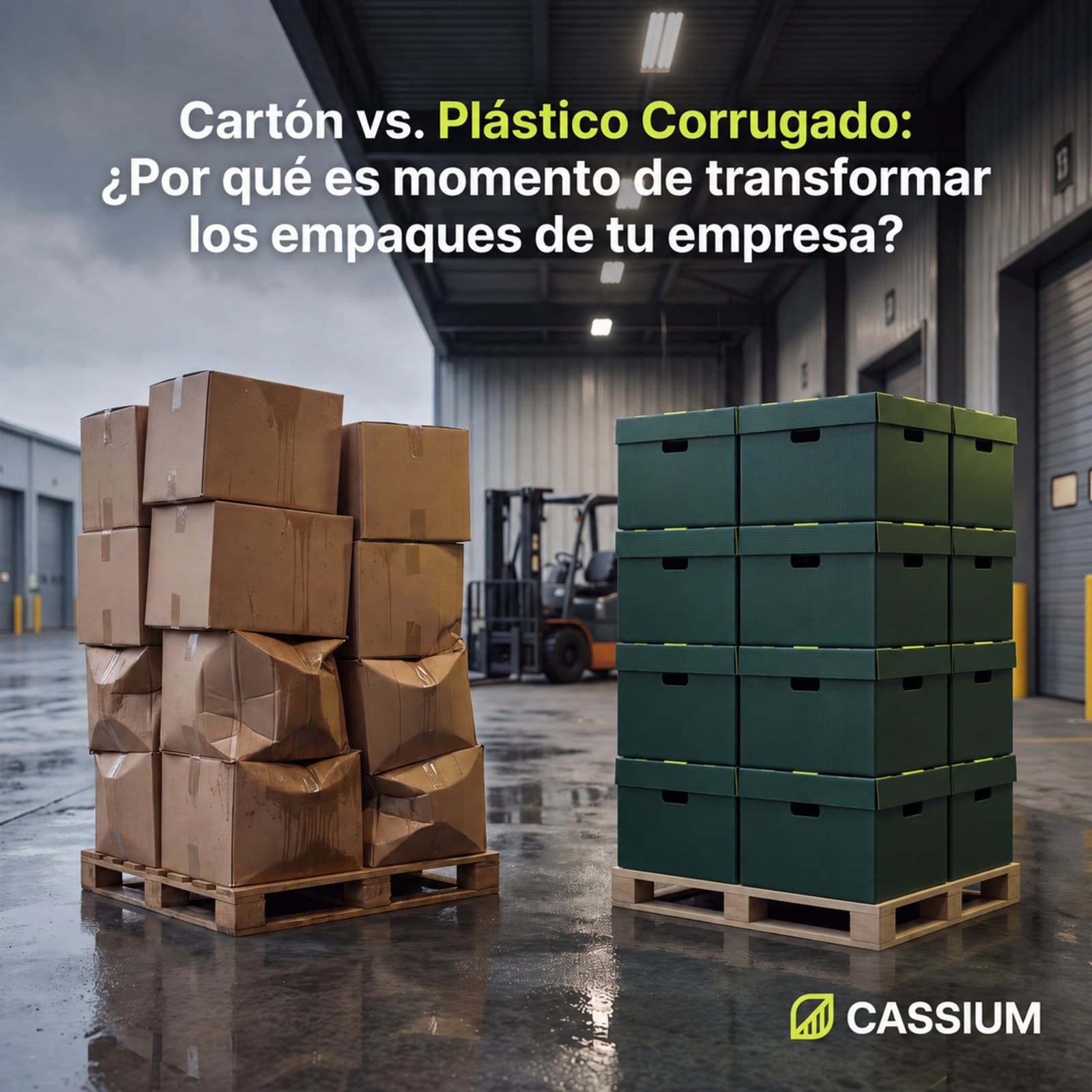
That yard scenario is the predictable behavior of a material designed for a single trip that you are asking to make ten, not an isolated accident. At Cassium we have spent more than five years manufacturing corrugated plastic sheet in Monterrey, and the conversation we have with operations and purchasing directors almost always starts at the same point: cardboard worked for years, until the operation grew and it stopped working. What follows is the technical detail of why it happens and when it makes sense to move the decision.
The three moments where cardboard gives way and your operation pays the bill
Corrugated cardboard is a cellulose fiber structure bonded with starch adhesive. That composition explains both its low cost and its three failure points. Knowing them lets you anticipate where in your process you are going to lose product.
Moisture: the fiber loses stiffness before the damage is visible
Water attacks both parts of the structure at the same time. It swells the cellulose fiber and dissolves the starch adhesive that holds the layers together. The result is a box that keeps its outer appearance while its compression strength has already dropped. That is the critical point: your supervisor has no way to detect the loss with the naked eye, because the cardboard looks the same the day it arrived and the day it fails.
In a Monterrey operation, with a rainy season, uncovered yards and transport that alternates outdoor heat with cold rooms, moisture exposure is constant. The operational implication is direct: any stacking calculation you made with the new box stops being valid after the first serious exposure.
Compression: the stack that held yesterday and doesn't today
The vertical compression strength of a cardboard box is measured when the box is freshly made. Under sustained load, the structure enters a process of progressive deformation that reduces that capacity over time. A stack calculated for five levels with a new box does not hold the same five levels after three weeks in the warehouse.
This is where many operations get surprised. The collapse does not happen the day the stack is built; it happens weeks later, when the material has been waiting for shipment. For your warehouse planning this means cardboard forces you to leave a safety margin in stacking height, and that margin translates into square meters of floor you are paying for without using.
Repeated handling: every loading cycle subtracts strength
The corners and vertical edges are the elements that hold the stack. Every forklift maneuver, every knock against a door frame and every manual rearrangement damages exactly that zone. Cardboard has no structural recovery capacity, so the damage accumulates trip after trip.
The commercial consequence is that the box coming back from a route is no longer equivalent to the box you bought. If your operation reuses cardboard for internal trips between plants or to a distribution center, you are working with packaging whose real load capacity is unknown.
Why the unit price hides the real cost of your packaging
The purchase order shows a single figure: the unit price of the packaging. That number is the one that wins the comparison in cardboard's favor, and it is also the one that leaves out most of the spend.
The spend that doesn't show up on the purchase order
On top of the purchase price you have to add the cost of waste disposal, the warehouse space the empty packaging occupies before being discarded, the replacement rate due to damage, the re-inspection labor when a stack fails, the product that is lost or degraded, and the contractual penalty if the shipment misses its window. In high-volume operations, the sum of those line items frequently exceeds the purchase price that originally justified the decision.
The exercise we recommend is simple and you can run it this week: take last year's total packaging spend, add the waste removal service invoice, and divide by the number of shipments. That is your real cost per shipment, and it almost never matches the number you have in mind.
The point where returnable packaging pays for itself
The returnable packaging literature places the break-even point between ten and fifty rotations, depending on the logistics model, the return distance and the washing cost. McKinsey points to around twenty rotations as the threshold beyond which a returnable system beats disposables in both cost and environmental footprint.
In automotive there are documented cases at that scale. Yanfeng Automotive Interiors reported ten million dollars in savings over twenty-four months after migrating from disposable packaging to reusable corrugated boxes across its supply network. The figure corresponds to a high-volume operation with closed routes and strict return control, which is exactly the scenario where the model performs.
Our sheet reaches up to 40 documented uses under normal handling conditions, so it clears the twenty-rotation threshold in the literature with room to spare. Cardboard, as a reference, delivers between one and three uses before it stops being reliable.
The question that decides the purchase, then, has nothing to do with which material costs less on the invoice. It has to do with how many trips your packaging makes per year inside a route you can control. If the answer exceeds twenty, the conversation has already changed subject.
What changes in your plant when packaging stops being disposable
Migrating to corrugated plastic modifies processes you take for granted today. It is worth knowing them before deciding, because some add administrative work you didn't have before.
Packaging becomes an asset with inventory
You stop buying packaging every month and start managing a fleet. That demands counting, an assigned owner and a defined return route. It is new administrative load and it would be dishonest to present it as a benefit. In exchange, your packaging spend stops being a recurring expense and becomes an investment you amortize.
Washing and sanitizing without sacrificing the piece
Polypropylene withstands water, detergent and disinfectant without losing structural properties. You can wash the same piece between cycles and return it to the line. For pharmaceutical, food or agricultural operations, where cross-contamination control is an audit requirement, this capability solves a problem cardboard simply cannot address, because a washed cardboard box is unusable.
The exact measurement eliminates adjustment on the floor
Manufacturing to spec means the sheet arrives with the dimensions, gauge and color you defined. Your staff stops improvising dividers, fillers and reinforcements to fit the part. That manual adjustment time, multiplied by shifts and months, is one of the savings items that shows up fastest and is almost never budgeted.
How we manufacture the sheet at Cassium
We manufacture at our Monterrey plant, with ISO 9001 certification, for the industrial, automotive, pharmaceutical, consumer and agricultural sectors. Every order is produced to spec in dimensions, gauge and color, and the internal flute of the corrugated is what defines the final strength of the piece. That is the point where it gets decided whether the sheet withstands your operation or only withstands the catalog.
Producing locally changes your delivery times. We work without imports or intermediaries, so a specification adjustment is resolved at the plant and not in a supply chain that crosses the ocean.
Recyclable at the end of the cycle, manufactured in Monterrey
There is one fact worth putting on the table honestly. Corrugated cardboard registers considerably higher recycling rates than polypropylene, and that fact is real and verifiable. The environmental advantage of corrugated plastic sheet is built another way: each piece displaces dozens of disposable units over its service life, and at the end the material re-enters the extrusion process. If someone presents corrugated plastic to you as superior in recyclability, they are omitting half the information.
If your operation moves product on repeated routes and packaging is already costing you more than what shows on the invoice, write to us at ventas@cassium.com.mx and we will review your case with the numbers from your own route.