
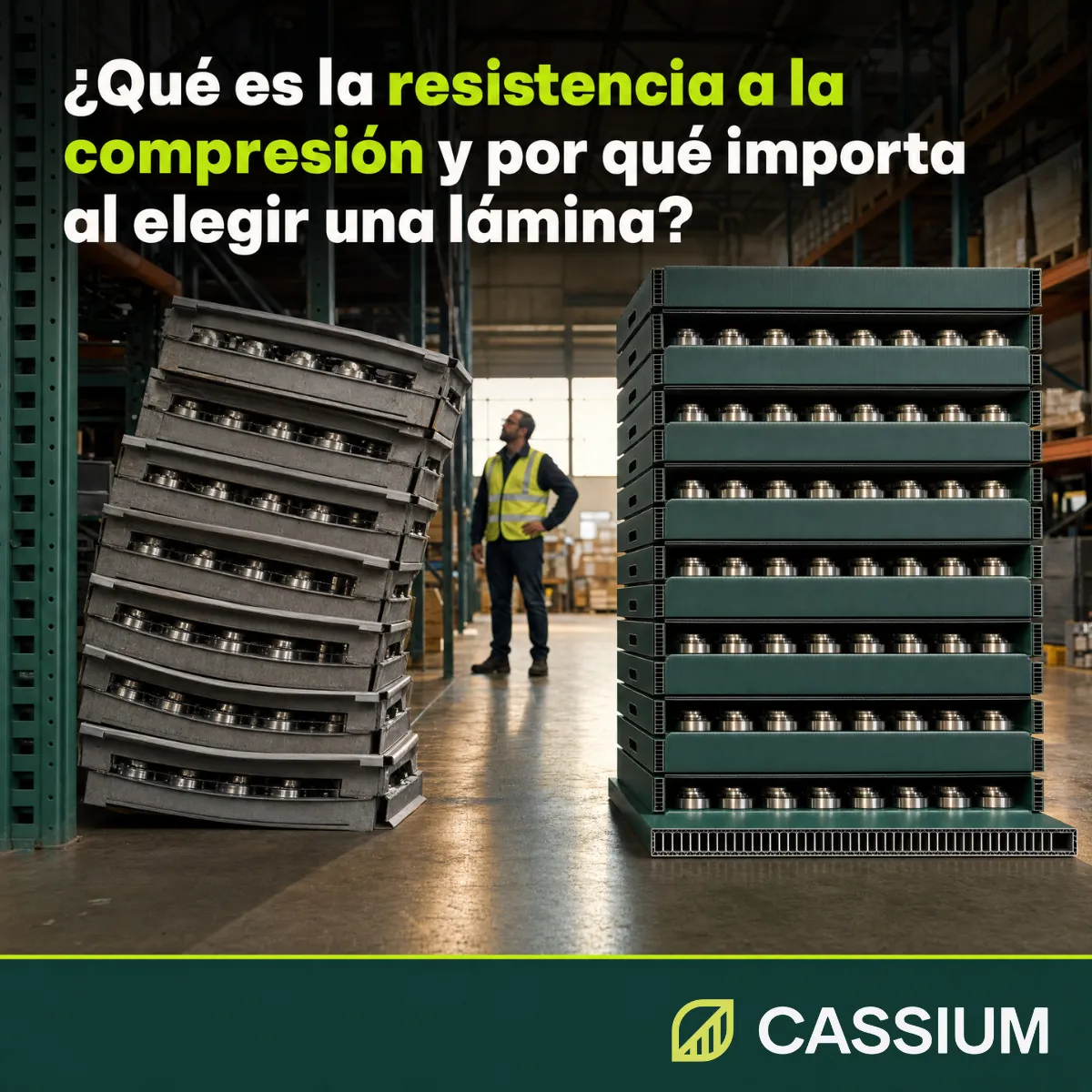
Compressive strength is the load a sheet withstands before it crushes or buckles. It depends on grammage, gauge, flute, time under load and temperature, and it decides how much your stack can hold.
What compressive strength means in a corrugated sheet
Compressive strength is a material's ability to withstand a force pushing it in on itself without crushing, bending or deforming permanently. For a solid plate, a single value would be enough, but corrugated sheet is a structure: two faces joined by ribs, with flutes running in a single direction. That is why its strength depends on which way the load pushes, and the same sheet can be very strong in one direction and give way easily in another.
In industrial packaging, that property decides almost everything that happens in a warehouse: how many levels a stack can hold, whether a loaded tray can support the one above it, whether a divider keeps the shape of its cell when the container travels full and whether a returnable box reaches its destination with straight walls.
The three ways a load defeats a sheet
Flat crush: when the ribs collapse
The first form of compression pushes the sheet face to face, as when a loaded tray rests on another or a heavy part sits on a divider lying flat. The entire load passes through the ribs, which work like small columns between the two faces. If the ribs are thin, they bend, the sheet loses gauge in that area and the top face is left marked with the shape of the part. That permanent imprint is the sign that the load exceeded the sheet's flat crush resistance.
Edge compression and buckling: when the wall bows
The second form pushes the sheet along its edge, with the sheet standing upright, as happens in the walls of a stacked box or in the vertical dividers of a container. Here the typical failure is buckling: the wall bows to one side until it loses its ability to carry the load. Buckling resistance increases with gauge, because separating the two faces makes the wall stiffer, and it depends on flute orientation, because ribs parallel to the load work as columns while perpendicular ones barely help.
Creep: the load the sheet holds today and gives way to on Tuesday
The third form is the one that explains the warehouse in the opening. Polypropylene, like all thermoplastics, deforms slowly when it carries a constant load for a long time, a phenomenon materials engineers call creep. A stack that holds perfectly for an hour can keep yielding little by little for days, and temperature speeds up the process: under sustained load, sheet in a hot building in summer deforms faster than sheet in a cool warehouse. That is why the useful question includes the weight, the time and the temperature at which the sheet will carry it.
Why gauge alone is misleading when you calculate a stack
It is common to specify sheet by gauge and assume that more millimeters mean more compressive strength. In buckling, that relationship holds fairly well; in flat crush, the result depends on how much material each rib has, and that is where grammage comes in.
Grammage: the material that actually carries the load
At the same grammage, a thicker-gauge sheet spreads its polypropylene into taller and therefore more slender ribs, which bend more easily under a face-to-face load. At the same gauge, a higher-grammage sheet has thicker faces and ribs and resists more in all three forms of compression. That is why our manufacturing matrix assigns a grammage range to each gauge, and why a sheet thinned out to lower its price loses compressive strength even though the caliper reads the same.
Flute orientation in load-bearing walls
In a box or a vertical divider, the flute should run in the same direction as the load, from top to bottom, so that each rib works like a column. The same wall cut with the flute horizontal loses a good part of its edge strength, and the difference shows up in the first tall stack. Orientation is defined on the part drawing and confirmed at cutting, before the part reaches the warehouse.
Corners, scores and supports: where the load concentrates
The load of a stack is rarely distributed evenly. It concentrates at the corners of a box, at the edges where one tray rests on another and along the score lines where the sheet was folded. A score that is too deep crushes ribs that can no longer carry load afterward, and a tray that rests only on its edges works more in bending than in compression. Checking where the load rests matters as much as choosing the right sheet.
How compressive strength is measured and what each test tells you
In the lab, compressive strength is measured with a press that pushes the sample at a controlled speed while recording the applied force. The key reading is the maximum load the sample withstands before it yields, and each form of compression has its own test.
Flat crush, edge and full part: three different tests
For flat crush, a square of sheet is placed flat between two parallel plates and compressed until the ribs collapse. For edge compression, a strip of sheet is placed upright, with the flute vertical, and compressed along its edge until it buckles. For a finished box or tray, the whole part is compressed between plates to measure how much it holds as a structure, with its corners, scores and joints. The three results are read differently, and the value from one test never replaces the value from another.
The sustained load test you can run at your plant
A press test lasts seconds and leaves out what happens to a stack over a weekend. That is what a simple test at your own plant is for: build a column with the real load and the real height of your warehouse, measure the total height and the deformation of the base part, and measure again the next day, after three days and after a week. If the deformation keeps growing after the first day, the stack is creeping, and it pays to move up in grammage, move up in gauge or drop one level. Run the test in the hottest season of the year or in the hottest area of your building.
How to turn compression into a purchase specification
Compressive strength is specified from the application. Before you ask for a gauge, define which form of compression dominates in your part, how much load it receives, how long it carries it, at what temperature and in which direction the flute runs. With that information, gauge and grammage stop being a gamble.
Our Recommender uses the strength level as the starting point for gauge: light strength, for temporary use, points to two or three millimeters; medium, for frequent handling and moderate loads, to three or four; high, for industrial use, stacking or impacts, to five or six; and very high, for returnable use or maximum demand, to six millimeters. That range is adjusted according to the application, and each gauge corresponds to a grammage range in our manufacturing matrix. With that proposal in hand, we send you a free sample so you can run the sustained load test with your part, your stack and your building before you commit volume.
If a stack that held on Friday was found collapsed on Tuesday, the sheet responded to a combination of load, time and temperature that nobody specified. At Cassium we make sheet from 2 to 6 mm with grammage controlled per batch, and we send you a free sample so you can test it under your real load before you decide. Find your starting gauge with our Recommender at https://cassium.com.mx/en