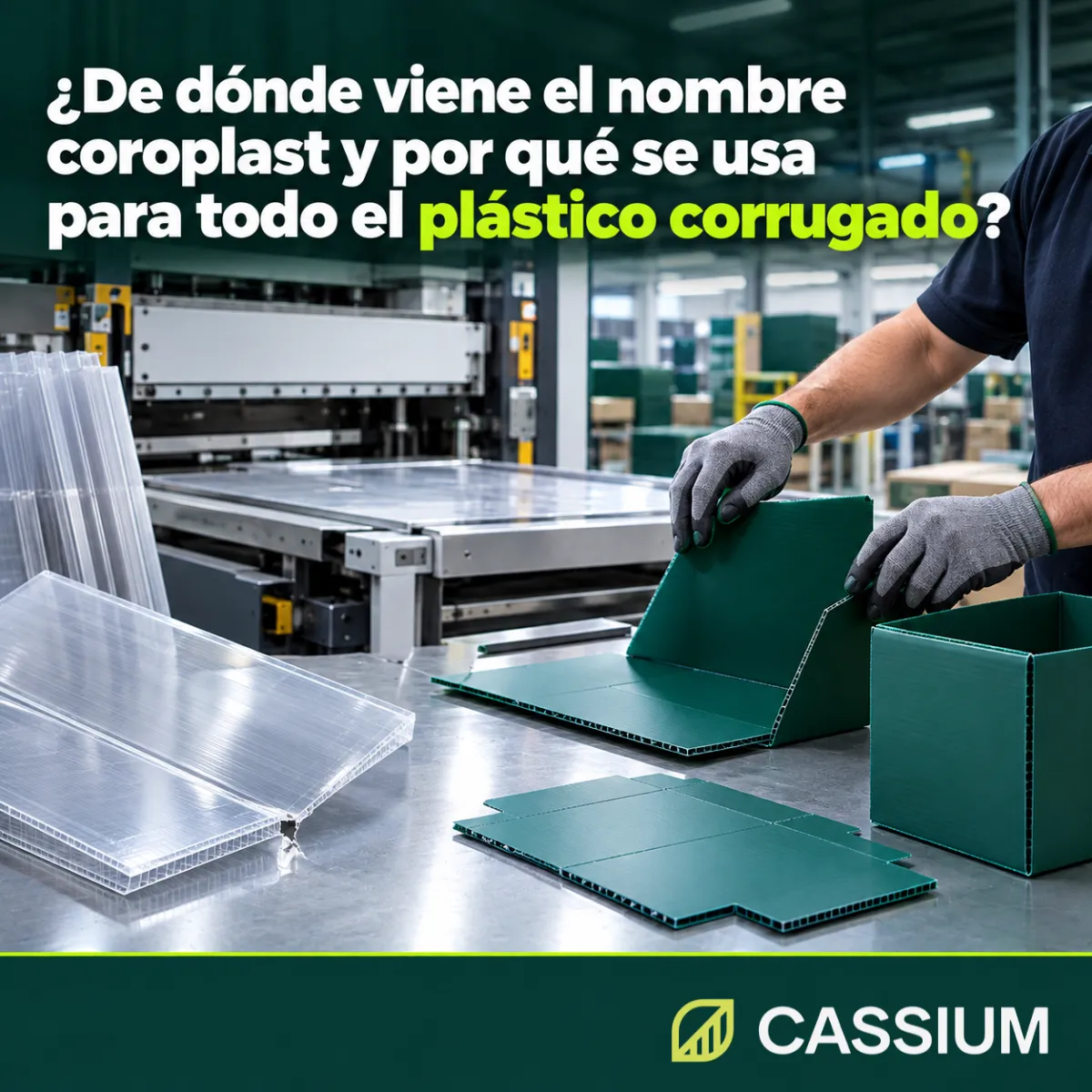
Coroplast began as a manufacturer's trade name, and usage turned it into the generic name for corrugated polypropylene sheet, which the English-speaking market calls corrugated plastic. The name helps you find it; the complete specification ensures you receive the right material.
How a trade name ended up naming an entire material
The word coroplast reads as the joining of two roots: the start of “corrugated” and the root of “plastic.” It began as the trade name under which one manufacturer sold its corrugated plastic sheet, and for years it was one brand among several. In Mexico, the market did the rest, and today the word describes the whole material, no matter who makes it. In English, the generic term the market uses for that same material is corrugated plastic.
When a brand becomes the name of its category
This happens often with everyday products. In almost any office in Mexico, clear adhesive tape and white glue are asked for by a brand name, even when the drawer holds another one. When a trade name is short, easy to pronounce and reaches a market early, people adopt it to name the entire product, and over the years they stop thinking of it as a brand.
The same thing happened with corrugated polypropylene sheet. Sign shops, printers, converters and packaging departments started saying coroplast to refer to any plastic sheet with two faces and internal flutes. In Mexico, it is the word people type most often into a search engine when they need this material, and that is why it is also the one we use so you can find us. In English, buyers usually search for corrugated plastic.
Why the term stuck in purchasing language
For years, much of the sheet used in Monterrey arrived through distributors from other regions of the country or from abroad, and the name traveled with it. Buyers ordered it by the name they knew, and that name made its way into requisitions, internal data sheets and shop floor vocabulary. In many plants, the engineer who designs the packaging, the buyer who requests quotes and the operator who die cuts the sheet use the same word for the same sheet, and that speeds up the conversation.
The risk appears when the word leaves the plant and reaches someone who does not know it, like the analyst in the opening. For that person, coroplast is an unfamiliar term that a search engine fills in with whatever it finds that looks closest.
What you are really ordering when you say coroplast
Behind the word is a specific material. Knowing its structure lets you recognize it in a quote and tell it apart from the products that look like it.
Polypropylene extruded as a double-wall sheet
The sheet the market calls coroplast is polypropylene extruded in a single piece, with two flat faces joined by ribs that form flutes along the length of the sheet. That geometry gives it stiffness at very low weight, and polypropylene adds resistance to moisture and to many chemicals. It also adds the ability to fold along a score again and again without breaking, which is the property that makes collapsible boxes, foldable trays and tabbed dividers possible.
The details the word leaves open
Saying coroplast identifies the material and leaves open almost every decision that determines whether the sheet works for your part. Gauge, which at our plant ranges from 2 to 6 mm, defines the distance between the faces. Grammage tells you how much polypropylene is in each square meter. Color can be whatever your operation needs, and the standard size that leaves our plant is 1.22 by 2.44 meters, with any other length and width made to order.
Then there is the variant, which depends on the conditions of use. Standard covers most packaging and indoor signage applications; UV carries a UV-inhibiting additive for parts that go outdoors; ESD dissipates electrostatic charge in electronics processes; and Agave incorporates agave fiber into the polypropylene compound. To the person ordering them, they are all coroplast, and each one solves a different problem.
Other names for the same material and the ones that lead to a different product
Coroplast is the most searched name in Mexico and corrugated plastic is the most common one in English, though several others circulate. If your team, your customer or a supplier uses another one, it helps to know when they mean the same sheet and when they mean something else.
Synonyms that describe the same sheet
Corrugated plastic and corrugated polypropylene are the clearest technical names, and they are the ones we use in our data sheets. Fluted polypropylene describes the same structure from another angle, because it names the internal channels. You will also hear corrugated plastic sheet, twin-wall sheet and, in some shops, plastic cardboard, because the material replaces cardboard in many applications. In Mexico, Spanish-language data sheets speak of plástico corrugado, polipropileno corrugado or polipropileno alveolar.
Multiwall polycarbonate: the look-alike relative that folds differently
The most expensive confusion is the one in the opening. Multiwall polycarbonate has a very similar structure, with faces and flutes, and is sold in similar gauges for skylights, roofing and partitions. It is a different, more expensive material, chosen for its transparency and impact resistance, and it lacks polypropylene's resistance to repeated folding. If a quote says multiwall or fluted and leaves out the polymer, ask about the material before you approve the purchase.
Corrugated sheet at a hardware store: the roof instead of the packaging
In construction language, corrugated sheet usually refers to wavy roofing panels made of metal, fiber cement or fiberglass. A search engine or a hardware store counter can steer you to that product if you only ask for corrugated sheet. Adding “polypropylene” to the search, or asking directly for corrugated plastic or coroplast, puts you in front of the right material.
When two suppliers mean different things with the same word
Even within corrugated polypropylene, coroplast covers sheets that behave very differently. Two quotes with the same name and the same gauge can describe materials your line cannot swap.
The sheet in a yard sign and the sheet in a container
The temporary sign staked in a lawn and the returnable box that travels full between two plants share the same polymer and structure. What sets them apart is grammage, gauge and often the formulation. A light sheet made to be printed and last one season costs less per sheet, and in an auto parts container it gives out within a few cycles. Anyone who buys only by name and price runs the risk of receiving the first when they needed the second.
How to turn the word into a requisition nobody misreads
Let the name coexist with the specification. A requisition that reads “coroplast (corrugated polypropylene), 4 mm and 650 g/m², white, Standard variant, in 1.22 by 2.44 meter sheets” keeps the word your plant understands and gives purchasing the details a supplier needs to quote without guessing. The word polypropylene, on its own, would have prevented the order in the opening.
If your team uses coroplast in its internal documents, add the technical name to the material data sheet and to the purchasing catalog. That way the term keeps working on the shop floor, and the person who is new to purchasing finds the right material from the first search. At receiving, simply check that the label and the technical data sheet say polypropylene before releasing the material.
What we make when you ask us for coroplast
At Cassium we extrude double-wall corrugated polypropylene sheet at our 5,000 m² plant in Santa Catarina, Nuevo León, under an ISO 9001:2015 certified quality management system. You can look for us by whatever name your plant uses (coroplast, corrugated plastic or fluted polypropylene), and we answer with the complete specification: gauges from 2 to 6 mm, Standard, UV, ESD and Agave variants, and the color your operation needs.
If you still do not know which gauge, grammage or variant to order, our Recommender suggests a starting point with four questions about your application. We then send you a free sample so you can test it on your line before your first order, and the word your team uses is backed by a sheet you have already validated.
If everyone in your plant says coroplast, the word is already doing its job; what is missing is for every requisition to pair it with the material and the details that make it unambiguous. At Cassium we make corrugated polypropylene sheet from 2 to 6 mm and help you go from the name to the specification. Find your starting gauge, grammage and variant with our Recommender at https://cassium.com.mx/en