
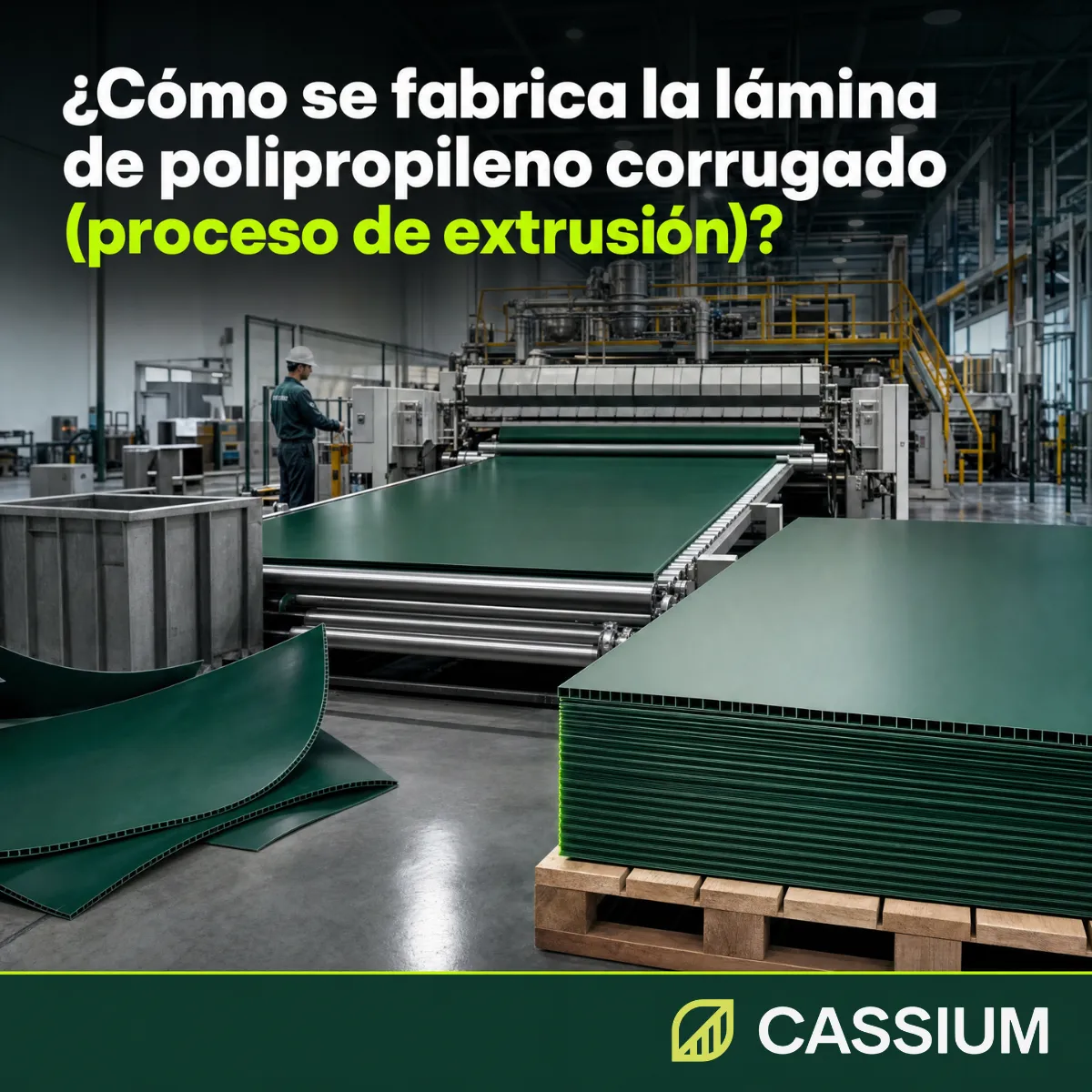
Corrugated polypropylene sheet is made by extrusion: the resin is melted, passes through a double-wall die, is calibrated, cooled under control and cut. Each stage defines gauge, grammage, flatness and stiffness.
The sheet starts to fail or to perform before it enters the extruder
When people talk about extrusion, they think of the machine, but the first decision in the process happens in the blend. Polypropylene enters the feed hopper as pellets, and along with it the components that define the variant are dosed in: the color concentrate, the UV additive for outdoor use, the antistatic additive of ESD sheet, the agave fiber of the bio-based version or the flame retardant when the application requires it. All of that is incorporated into the mass of the material and travels with the sheet throughout its service life.
Dosing: the proportion that decides whether two batches come out the same
A poorly dosed additive produces a sheet that looks right and behaves differently. With too little UV stabilizer, the sheet turns brittle in the sun ahead of time; with an irregular color concentrate, shade streaks appear that the end customer detects at the first inspection; with a variable proportion of recovered material, stiffness changes from one pallet to the next. That is why dosing is controlled by weight and recorded per run, and why the recipe for each variant is documented before the line starts up.
Recovered material: what goes back into the process and under what control
Every extrusion plant generates edge trim, line start-up material and off-spec pieces. At Cassium, that surplus material is ground and fed back into the production process in a controlled proportion, so the trim becomes new sheet and stops being industrial waste. The difference compared with recycled material of unknown origin lies in traceability: we know what resin it is, which variant it came from and in what proportion it returns to the blend.
From screw to die: the stretch where an error becomes permanent
Once dosed, the blend drops into the extruder barrel, where a screw conveys it, melts it and homogenizes it. Whatever happens along those few meters is frozen into the sheet, because after the die there is no way to correct a poorly melted blend.
Zone melting: stable temperature and pressure
The barrel works with several heating zones, each with its own control temperature, and the screw supplies the rest of the heat through friction as it compresses the material. The goal is to deliver molten polypropylene to the die with uniform viscosity and at constant pressure. When the temperature swings or the pressure pulses, the flow reaching the die changes from one second to the next, and that translates into thickness variations along the sheet that the caliper detects as irregular gauge and that your die-cutting operator detects as pieces that do not seat the same way.
Filtering: what gets stopped before it reaches the die
Before the die, the molten material passes through a screen that retains unmelted particles, contaminants or lumps of poorly dispersed additive. A particle that gets through becomes a weak point inside a rib, or a visible grain on the face that ruins a print. Changing screens on time is one of those maintenance tasks the customer never sees, and it explains a good part of the difference between one manufacturer's sheet and another's.
The profile die: distributing the flow from edge to edge
The die is the part that shapes the double wall: the melt exits through an opening with the profile of the two faces and of the ribs that join them, in a continuous band as wide as the sheet. Its main challenge is to distribute the flow evenly across the full width. If the center receives more material than the edges, the sheet comes out thicker in the center and thinner at the edges, and that difference shows up later as pieces that weigh differently depending on the part of the sheet they were cut from.
Calibration and cooling: the meters where warped sheet is born or avoided
As it leaves the die, the band is still soft and without its final shape. The next stages set the gauge, remove the heat and decide whether the sheet will stay flat in your warehouse or bow days later, as in the divider run from the opening.
The calibrator: where the distance between faces is set
The hot band enters a calibrator that holds the two faces against its plates while the material begins to solidify. That is where the final gauge of the sheet is defined, from two to six millimeters. If the plates lose parallelism or the cooling inside the calibrator is uneven between the top and bottom faces, the sheet comes out with the correct gauge and with a different internal stress in each face.
Asymmetric cooling and internal stresses
Polypropylene shrinks as it cools. When one face cools faster than the other, each one shrinks at a different moment, and the difference stays trapped in the material as internal stress. That stress can take hours or days to show, especially when the sheet is cut into small pieces or is exposed to heat in the warehouse. A well-tuned line cools both faces symmetrically and gives the material the time it needs to stabilize before cutting. The sheet that bowed in the divider run met gauge and grammage; its defect came from a poorly controlled thermal history.
The puller: the speed that defines grammage
After cooling, a set of rollers pulls the band at constant speed. That speed, combined with the amount of material the extruder delivers, determines how much polypropylene ends up in each square meter. With the same die and the same gauge, a faster puller stretches the material and leaves thinner faces and ribs; a slower one leaves more mass. That is how the same gauge is made in different grammages, and that is also how a sheet gets thinned out to lower its price without the caliper noticing. At our plant, grammage is controlled per batch and verified by weighing samples of known size.
Finishing, cutting and inspection: what separates a continuous band from an acceptable batch
At this point the band already has its gauge, its grammage and a stable shape. What remains is to prepare it for its final use, cut it to size and confirm that the batch meets what was promised in the quote.
Corona treatment: the surface that anchors the ink
Polypropylene has a low-energy surface that repels most inks. When the sheet is going to be printed, for signage, advertising or packaging identification, corona treatment is applied: an electrical discharge that modifies the surface and allows the ink to anchor. An untreated sheet accepts the print at first and loses it with the first rub or the first wash. That is why the treatment is requested from the quote onward, just like gauge and color.
Edge trimming and cutting to size
The band is trimmed at the edges to leave the exact width and cut crosswise to the required length. The standard size that leaves our plant is 1.22 by 2.44 meters, and we also make to order in any length and width within the 2 to 6 mm range. Cutting to size at extrusion reduces scrap at your plant, because you receive the sheet your die needs instead of one your team has to trim.
Batch verification under ISO 9001
Before a batch goes out on pallets, the gauge is checked at several points across the width, a sample is weighed to confirm grammage, flatness is inspected and color is compared against the approved standard, and everything is recorded with the run identification. Our quality system is certified under ISO 9001 across all processes, from the moment the resin comes in until your order ships, and those records make it possible to trace any deviation back to the exact stage of the process where it occurred.
What the process reveals when you evaluate a supplier
Knowing the stages of extrusion gives you another way to evaluate sheet. Beyond comparing price and gauge, you can ask how additives are dosed, how grammage is controlled, how the sheet is cooled and what records are kept for each run. A manufacturer with in-house extrusion answers those questions with data from its own line; a middleman has to pass them on to a plant it does not know either.
At Cassium we extrude at our 5,000-square-meter plant in Santa Catarina, Nuevo León, with extrusion, cutting, ultrasonic welding and warehousing under one roof. If you want to see the process before your first order, you can visit the plant: you see extrusion live and the quality control, and you talk directly with the team that makes your sheet.
If a sheet that met gauge and grammage bowed, got stained or lost its print at your plant, the cause almost always lies in an extrusion stage nobody explained to you. At Cassium we make every batch on our own line, with run records under ISO 9001, and we send you a physical sample before you commit volume. Learn about the process, the variants and the gauges at https://cassium.com.mx/en