The Three Points Where an Import Supply Chain Leaves Your Plant Without Packaging
When corrugated sheet arrives from Asia or from a country with no local plant in Mexico, the order passes through at least three points where it can fail without your purchasing team having any control over the cause. The first is ocean transit, where a delay at the port of origin, a route change, or a customs inspection adds weeks that no supplier confirms with a firm date. The second is the minimum production order, which foreign factories usually set at high volumes of a single gauge, forcing your plant to buy more material than it needs just to justify the production run. The third is the last-minute adjustment: if the gauge that arrives doesn't match what your packaging line requires, the correction goes back through the same production and transport cycle that already took weeks.
Ocean and Customs Transit That No Contract Guarantees
An importing supplier's quote almost always includes an estimated transit time, not a committed one. That distinction looks minor on paper, but in practice it means your plant absorbs the risk of any delay at the shipping line, the port of origin, or Mexican customs, with no real contractual penalty for the supplier. For an operation working under the nearshoring model, where the end client demands ever-shorter delivery cycles, that risk translates into a safety inventory higher than it should need to be, with the financial cost of keeping it tied up in the warehouse.
The Minimum Order That Forces You to Buy Gauge You Don't Need
Manufacturers that export corrugated sheet to Mexico usually set minimum production volumes per gauge so the extrusion run is profitable from their plant of origin. If your operation needs different gauges for different lines, for example 3 mm for internal separators and 5 mm for returnable containers, you end up managing excess inventory of each gauge just to meet the supplier's minimum. That excess takes up warehouse space, ties up working capital, and complicates material rotation within your plant's quality system.
Why an Importer's Technical Support Stops at the Email Inbox
When a technical question comes up, for example whether a 4 mm gauge can hold the weight of your product on a storage rack, or whether the antistatic variant is compatible with your electronic assembly line, the response channel of a supplier with no plant in Mexico is almost always limited to email and calls across time zones. There's no technical visit to your plant, no physical sample for a fast response, and no real-time formulation adjustment. Your operation's quality team is left waiting for a confirmation that can take days just to get scheduled.
Without a Local Plant, Every Specification Adjustment Restarts the Full Cycle
When the manufacturer is a flight or several weeks away, any specification adjustment (thickness, UV treatment, electrostatic dissipation) requires a full new production cycle from the point of origin, with the same transit time you already know. That turns any quality issue detected at your material receiving dock into a problem that takes weeks to fix, while your line keeps running with the questioned lot or stops entirely while it waits for replacement material.
What Changes When Extrusion Happens a Few Hours From Your Plant
At Cassium we run our own extrusion line at a 5,000-square-meter plant in Monterrey, certified under ISO 9001:2015. That means we control the entire process, from polypropylene resin to the final corrugated sheet, without depending on a third party to produce the gauge your operation needs. We manufacture gauges from 2 to 6 mm in the Standard, Agave, UV, and ESD variants, and we keep stock of our highest-turnover gauges on hand to supply without waiting for a full new production cycle.
Our Own Extrusion: Gauge Control From Start to Finish
By controlling extrusion inside our own plant, we adjust gauge and formulation before the material moves to mass production, and we verify every lot under the same quality management system that supports our ISO 9001:2015 certification. If your operation needs a specific variant, such as electrostatic dissipation for electronics and battery manufacturing lines, or UV treatment for prolonged exposure at construction sites, the adjustment is resolved within our own process, without depending on instructions that cross a border or a third party reinterpreting your specification.
Delivery in 3 to 5 Days in Nuevo León, No Port Layover
From our plant in Monterrey we deliver to Nuevo León in 3 to 5 business days, without going through a port, a customs broker, or an international shipping line. For plants in automotive, food, beverage, pharma, and logistics operating under the nearshoring model, that geographic proximity reduces the safety inventory you need to keep and lets you react to a sudden demand change without waiting weeks for a container. It's a level of support that a supplier without a plant in Mexico can hardly match without investing in the same local infrastructure.
The Hidden Cost of a Gauge That Shifts From Lot to Lot
A buyer who only checks the price per sheet can overlook the fact that an imported sheet's gauge varies slightly between different production cycles, especially when the supplier combines orders from several clients on the same extrusion line on the other side of the world. That variation, even if it seems small, affects how you adjust your cutting or die-cutting equipment and can generate waste that never shows up in the original quote or in the cost your finance team projected for the order.
ISO 9001:2015 Traceability on Every Extrusion Cycle
Every production cycle at our plant is documented under the procedures of our ISO 9001:2015 quality management system, which lets us track the exact gauge and variant you received, lot by lot. If your quality team needs documented evidence for a client audit or a certification audit, that traceability is available without depending on an intermediary or on a manufacturer outside the country that takes weeks to respond to a documentation request.
What's Worth Reviewing Before You Sign Your Next Purchase Order
Before comparing price per sheet between an importing supplier and one with a plant in Mexico, it's worth having your purchasing team quantify the real cost of each additional week of transit, the capital tied up in safety inventory, and the time your operation loses every time a technical adjustment depends on a factory outside the country. That comparison usually changes the decision faster than any price list.
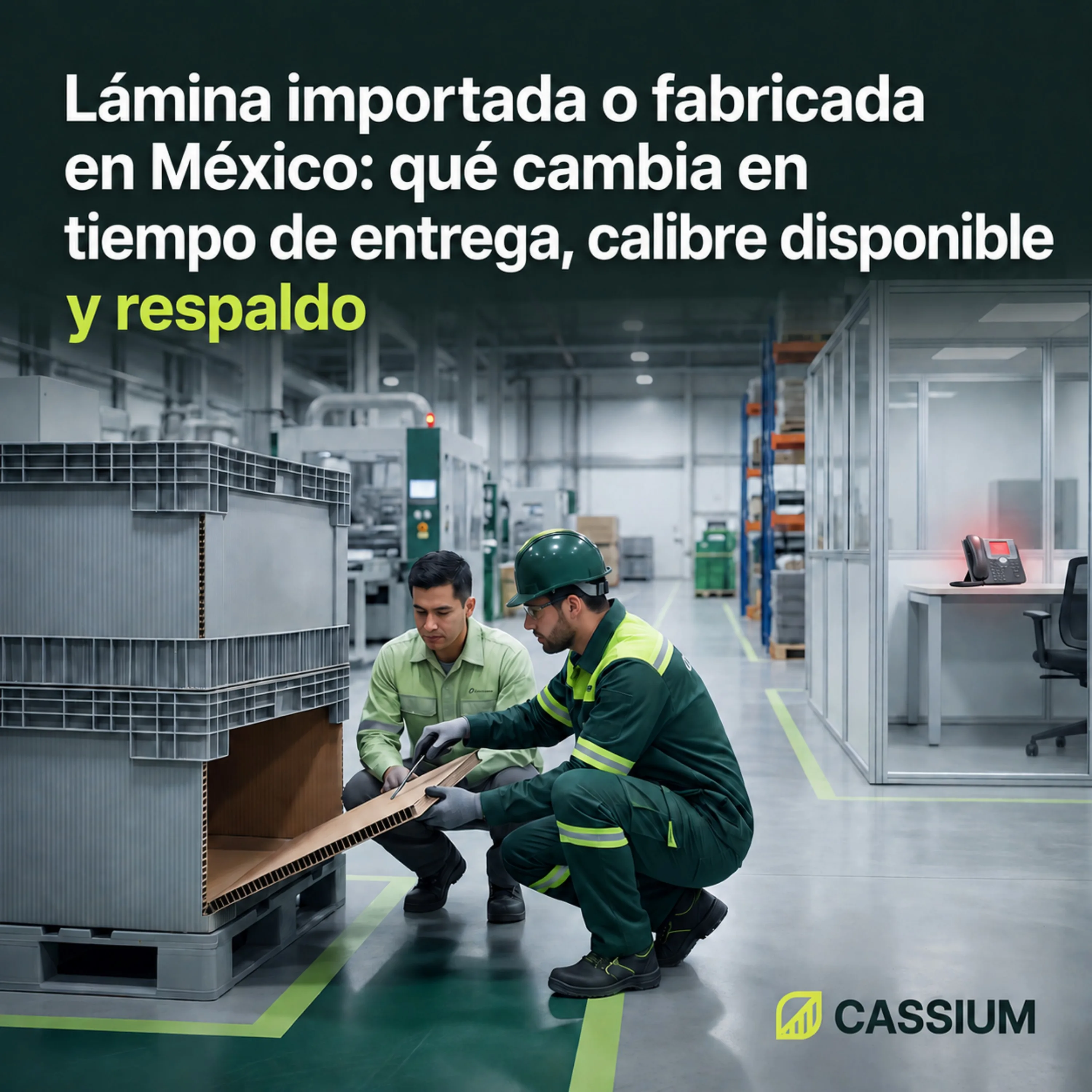
Choosing between imported sheet and Mexican-made sheet means evaluating how much risk in lead time, available gauge, and technical support your plant is willing to absorb on every order, beyond the price per sheet on the initial quote.