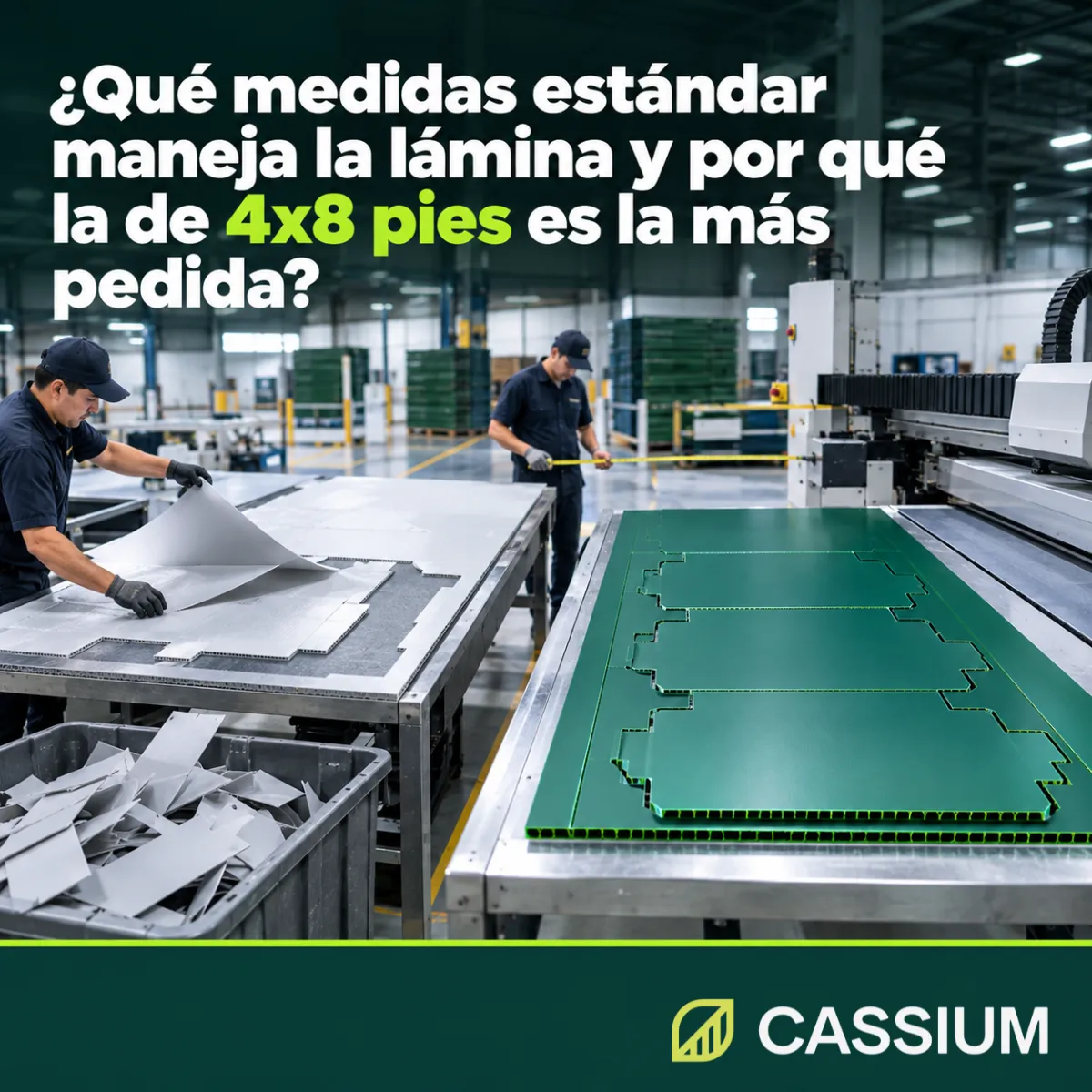
Our standard size is 1.22 by 2.44 meters, the equivalent of the 4x8 foot sheet. It is the most requested because it matches the format of panels, cutting tables and converting machines.
Why dividing areas misleads you about how many parts come out of a sheet
A 1.22 by 2.44 meter sheet has 2.98 square meters, and that figure is useful for estimating weight and cost per area. To know how many parts you will get, the useful figure is a different one: how many times your part's blank fits across the width and along the length of the sheet. Area ignores shape, and shape decides yield.
Nesting: how many times the part fits in each direction
Take the sheet width, 122 centimeters, and divide it by one of your part's dimensions; take the length, 244 centimeters, and divide it by the other. Keep the whole number of each division and multiply them. Then repeat the calculation with the part rotated 90 degrees and compare the two results.
A 60 by 120 centimeter blank gives two parts across and two along, four per sheet with only a few centimeters left over. One of 64 by 125 gives a single part, because the 125 centimeters exceed the width and more than a meter is left over along the length. The two parts take up almost the same area, and one yields four times as much as the other.
Edges, spacing between parts and flute direction
The real calculation subtracts something on each side. The die or the saw needs a margin at the edges and a gap between parts, and that margin depends on your tooling. If the part has scores for folding, they should cross the flutes of the sheet, because a fold along the flute collapses the ribs; that sets the direction in which the part can be nested. A part that yields four per sheet on paper can drop to three once you add margins and respect flute direction, so do the nesting with your tooling before you quote.
The standard size that leaves our plant
At Cassium, all of our standard gauge and grammage combinations are made in 1.22 by 2.44 meter sheets. It is the format we already produce on a regular basis and that ships without an additional cutting step. Any other length and width is made to order, within the 2 to 6 mm range.
Seven gauge and grammage combinations in the same format
Our standard size table includes 2 mm sheet at 400 g/m², 3 mm at 550, 4 mm at 600, 650 or 700, 5 mm at 1,000 and 6 mm at 1,300, all in 1.22 by 2.44 meters. If your application fits one of these seven combinations, you work with the format the entire market knows. The other combinations in our grammage table, such as 3.5 mm sheet, are made to order.
Sheets per pallet: a stack of about one meter
Each standard combination ships on a pallet with a fixed number of sheets: 500 in 2 mm, 330 in 3 mm, 275 in 4 mm, 200 in 5 mm and 160 in 6 mm. If you multiply sheets by gauge, they all form a stack of sheet about one meter high. With the grammage and the 2.98 square meters of each sheet, the 2 mm pallet at 400 g/m² adds up to about 600 kilos of sheet, the 4 mm pallet at 600 g/m² comes to around 490 and the 6 mm pallet at 1,300 g/m² reaches about 620, not counting the base.
Those numbers help you plan. They tell you how many pallets an order takes up, how much each one weighs for your forklift and your rack, and how many finished parts a pallet represents once you know the yield per sheet. With 275 sheets of 4 mm and a four-part nest, one pallet equals 1,100 blanks; with a one-part nest, it equals 275.
Why the 4x8 foot sheet is the most requested
The 1.22 by 2.44 meter sheet is the rounded conversion of 4 by 8 feet. A foot measures 30.48 centimeters, so 4 feet equal 121.9 centimeters and 8 feet equal 243.8. Its popularity has little to do with corrugated plastic itself and a lot to do with everything around it in a shop.
A module inherited from panels and construction
In North America, plywood, MDF, drywall and many other sheet materials are made in 4 by 8 feet, and in Mexico those panels are sold as 1.22 by 2.44 meters. Shops, woodworkers, sign makers and maintenance departments have worked with that format for decades, so their tables, their shelving and the way they plan a cut are already designed around it. When corrugated plastic arrived in those same shops, it adopted the size everyone knew how to handle.
Cutting tables, routers and printers built for that sheet
Many cutting tables, CNC routers, cutting plotters and flatbed printers are built with a work area that takes a full 4x8 foot sheet. With that format, the sheet goes into the machine without being trimmed first and you use its entire surface in a single load. A larger sheet forces you to trim before processing, and a smaller one leaves part of the usable area idle in every machine cycle.
A known yield and quotes that are easy to compare
As the reference format, the 4x8 sheet is the one packaging and signage designers use as the basis for nesting parts and the one buyers compare across quotes. For your plant, that means a price per sheet that is easy to compare across suppliers, a yield your team already knows by heart and a sheet that leaves the plant ready to go into your process.
When the standard size stops being the best option
The 1.22 by 2.44 meter sheet covers most orders, and even so, some parts nest poorly on it. Recognizing them in time keeps you from repeating the case in the opening.
Three signs that your part calls for a different format
The first is high scrap that persists even after you rotate the part and adjust the margins. The second appears when the part is larger than the sheet on one of its sides, such as a long divider for a container or a protective cover for a large surface. The third is handling: some lines work better with smaller sheets that one person can carry and place in the machine. In those cases we make the sheet in the length and width your part needs, and it is worth comparing the cost of that sheet against the scrap of the standard one before you decide.
How to design your part to get the most out of the 1.22 by 2.44 sheet
The best time to solve yield is before the die is made. If your part design has some leeway, adjust its dimensions so they divide well into the 122 centimeters of width and the 244 of length: dimensions close to half, a third or a quarter of each side, minus your tooling margins. In the opening case, reducing the blank from 64 by 125 to 60 by 120 centimeters would have turned each sheet into four boxes.
What to put in writing before you order
When you order the standard size, write the format in meters on the purchase order, 1.22 by 2.44, along with the gauge, grammage, variant and color. If your part has scores, confirm with your supplier which way the flute runs relative to the length of the sheet, so you can nest the parts on the die with the folds crossing the flute. And validate the nest with a real sheet before you lock in the price with your customer.
At Cassium we extrude corrugated polypropylene sheet from 2 to 6 mm at our 5,000 m² plant in Santa Catarina, Nuevo León, with batch records under our ISO 9001:2015 quality management system. Our standard 1.22 by 2.44 meter sheet comes in seven gauge and grammage combinations, and we send you a free sample so you can validate your part's nest on your own tooling before you commit volume.
If your part was designed in centimeters without thinking about the sheet, check its nesting before the die is made; a few centimeters of adjustment can multiply the parts you get from each sheet. At Cassium we make 2 to 6 mm sheet in a standard 1.22 by 2.44 meter size and in any other size to order. Find your starting gauge, grammage and variant with our Recommender at https://cassium.com.mx/en