
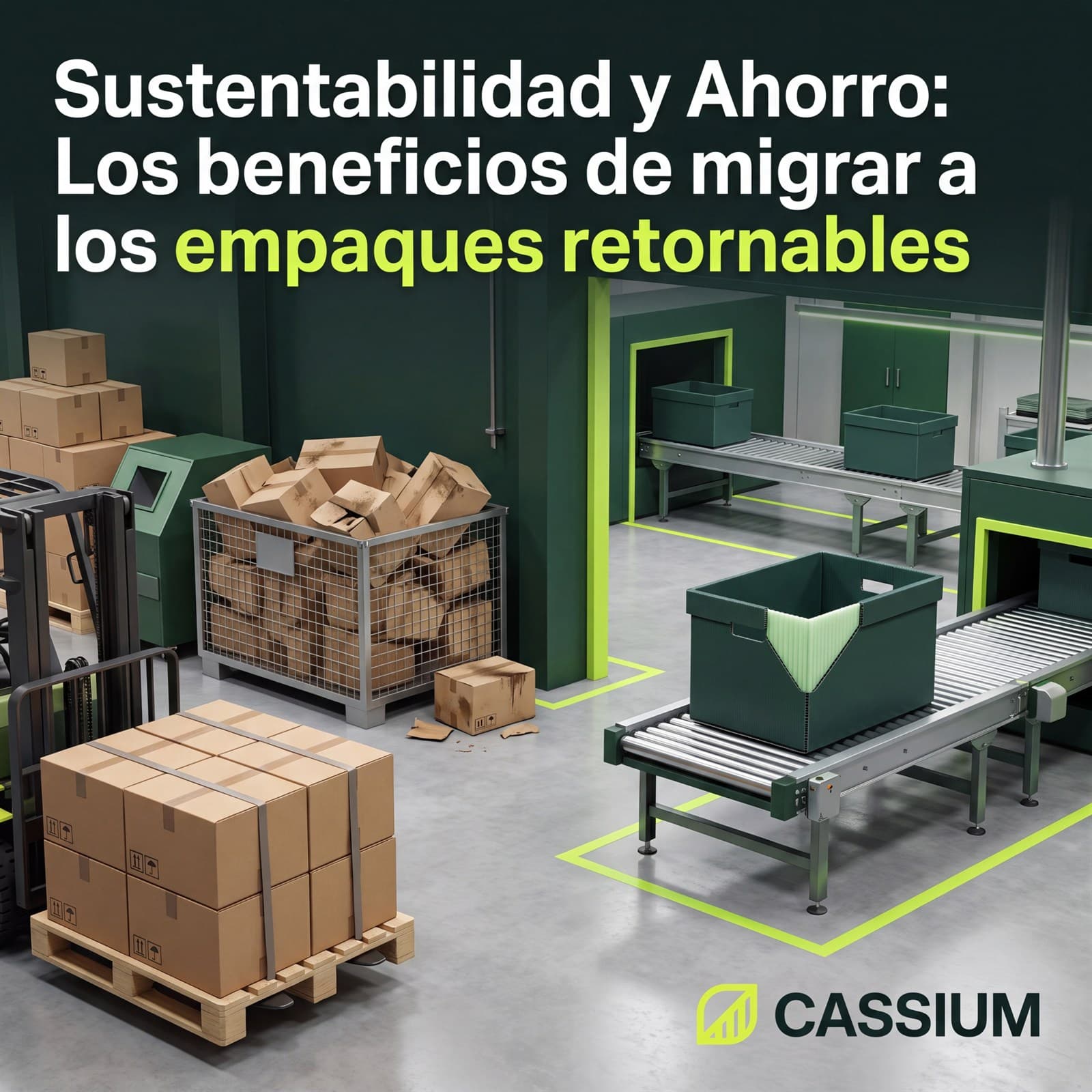
The conversation about sustainability in packaging usually stops at the material. In practice, what decides both the environmental impact and the financial result is the number of times the same piece returns to the route. At Cassium we manufacture corrugated plastic sheet in Monterrey for the industrial, automotive, pharmaceutical, consumer and agricultural sectors. What follows is the framework you can use to evaluate whether your operation is ready for the change, including the scenarios where it isn't worth making.
The double cost of disposable packaging almost nobody accounts for
In most plants, packaging shows up as a single expense line. When you open it, you find two money flows running in different directions that are rarely added together.
Purchase, single use and disposal
The first flow is the purchase price, reviewed every year and negotiated with the supplier. The second is the waste removal service, usually managed from maintenance or general services and never crossed with the first. When both are added and divided by the year's number of shipments, the real cost per shipment appears. That number is usually considerably higher than the one the purchasing area has in mind.
The implication is concrete for your budget: every disposable box that enters your plant carries an exit cost that is already committed at the moment of purchase, even if it gets paid months later and from another cost center.
The yard that fills up with what no longer serves
Spent packaging occupies space while it waits for removal. In high-volume operations, that space competes directly with maneuvering area and with storage surface for finished product. There are plants renting additional square meters to store product because their own yard is occupied by packaging waste in transit to the container.
On top of this comes an operational risk that materializes on the next shift: discarded material and good material end up mixing when both share the same space, and that mix gets resolved with hours of staff reclassifying.
Why packaging sustainability is measured in cycles
The correct environmental criterion for comparing two packaging systems is total impact divided by the number of uses. A material with a larger manufacturing footprint can turn out better if its service life is long enough, and worse if the operation discards it early.
How many trips a returnable needs to win
The returnable packaging literature places the break-even point between ten and fifty rotations, varying with return distance, washing cost and the system's loss rate. McKinsey puts around twenty rotations as the threshold beyond which the returnable model beats disposables in cost and environmental footprint simultaneously.
In automotive there are cases confirming the scale. Yanfeng Automotive Interiors reported ten million dollars in savings over twenty-four months after migrating to reusable corrugated boxes within its supply network. That result corresponds to an operation with closed routes and strict return control, and that detail is the part most often omitted when the case gets cited.
The scenario where the returnable model fails
It is worth saying clearly because it goes against the sales pitch. If your packaging doesn't come back, the returnable model loses. An open-loop operation, where packaging travels to a customer with no obligation or return route, turns every returnable piece into an expensive disposable. In that scenario cardboard remains the correct decision and that is what we tell whoever consults us.
The minimum condition for the migration to work is a return route with an identified owner, documented counting and a defined consequence for loss. Without those three elements, the shrinkage rate eats the savings before the first year.
What the recycling figure doesn't tell
Corrugated cardboard registers recycling rates far higher than polypropylene's, and that figure is verifiable and published by the cardboard industry itself. Presenting it any other way would be dishonest. The environmental advantage of returnable packaging is built a different way: a single piece replaces dozens of single-use units over its service life, and that accumulated displacement weighs more in the balance than the material's recycling rate at the end of the road. When its cycle ends, the polypropylene in the corrugated sheet returns to the extrusion process.
What your operation needs before migrating
The migration to returnables is a process change before it is a material change. These are the three conditions worth having resolved before switching packaging.
A return route with an owner and counting
Someone has to own the packaging inventory. In operations that work, returnable packaging is managed as an asset: it has counting by location, periodic cutoffs and a person who answers for shrinkage. When that figure doesn't exist, pieces scatter across plants and customers until nobody knows how many there are or where they are.
A washing protocol that doesn't damage the piece
Polypropylene withstands water, detergent and disinfectant without losing structural properties, which allows returning the same piece to the line between cycles. For sectors with sanitary audit requirements, such as pharmaceutical, food and export agriculture, that washing must be documented as part of the procedure. Defining the frequency, the chemical and the drying method from the start keeps the practice from being improvised on the floor.
A pilot before the full switch
We recommend starting with a single route and a single part number for one quarter. That pilot delivers the figure no supplier can give you in advance: how many cycles your packaging actually completes in your conditions, with your staff and your type of handling. With that number in hand, the business case for the rest of the operation gets built on your own evidence.
How we work this migration at Cassium
We manufacture corrugated plastic sheet to spec at our Monterrey plant, with ISO 9001 certification, for the industrial, automotive, pharmaceutical, consumer and agricultural sectors. We define dimensions, gauge and color with you based on the part you transport and the real conditions of your route.
Our sheet reaches up to 40 documented uses under normal handling conditions, above the twenty-rotation threshold where the returnable model starts to perform. That margin is what gives you room to absorb shrinkage without losing the business case.
Manufacturing locally changes the migration's timeline. We work without imports or intermediaries, so a specification adjustment during the pilot is resolved at the plant and not in a supply chain that crosses the ocean. For a project that needs to iterate on the design before scaling, that time difference determines whether the pilot finishes within the quarter or drags on for a year.
If you are evaluating the migration and want to run the number with the data from your own route, write to us at ventas@cassium.com.mx and we will build the analysis with your real operation.