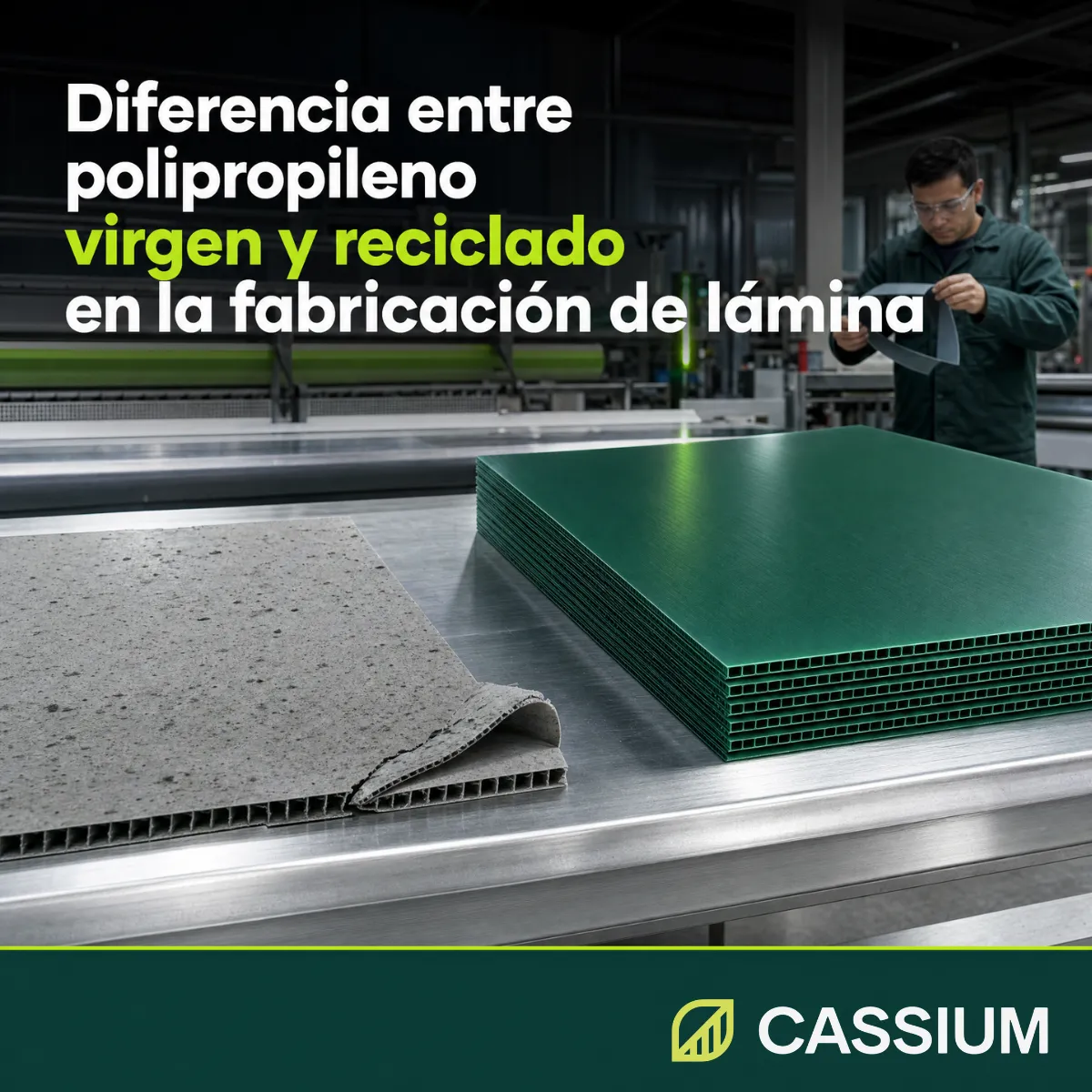
Virgin polypropylene arrives with known properties; recycled material carries a thermal history and possible contaminants. With controlled source, ratio and formulation, both make good sheet; without that control, recycled material changes from one batch to the next.
What recycled polypropylene brings from its first life
Virgin polypropylene leaves the petrochemical plant as pellets of a specific grade: homopolymer or copolymer, with a declared melt flow index and a stabilizer package designed for processing. Anyone who extrudes sheet with those pellets knows what will go into the hopper from every bag. In our article on what polypropylene is, we explain those two families; here we focus on what changes once the material has already been melted, used and recovered.
Recycled polypropylene is the same polymer with a history attached. It has already gone through at least one melt cycle, worked under exposure to heat, light or chemicals and, in many cases, been mixed with other materials before reaching the recycler. That history leaves three marks that explain almost every difference you will notice in the sheet.
Thermal history: every melt shortens the chains
Every time polypropylene melts and passes through the shear of the screw, part of its molecular chains breaks. In the lab, the effect shows up as a higher melt flow index: the material flows more easily because its chains are shorter. In the sheet, that loss translates into lower impact resistance, less tolerance to repeated folding and more brittleness in the cold, which are precisely the properties that make polypropylene valuable in returnable packaging. That is why recycled material is formulated with fresh stabilizers and blended in proportions the virgin resin can compensate for.
Mixed grades and mixed polymers: the recipe nobody chose
A batch of post-consumer recycled material gathers parts from many sources: caps, buckets, raffia, auto parts and containers. Each one was made with a different grade, and the blend averages out melt flows and stiffness values nobody specified. If it also contains polyethylene, which looks and feels almost the same, the problem grows, because the two polymers blend poorly in the melt and form weak zones where the sheet cracks or delaminates. Some recycled materials also carry mineral fillers, such as talc or calcium carbonate, which raise density and change the actual grammage of the sheet without the gauge giving it away.
Contamination: black specks, gels and odor
Labels, adhesives, inks, residue from whatever the container held and particles of metal or dirt travel with the recovered material. The extruder's screen pack stops the largest particles, and whatever gets through shows up in the sheet as black specks, translucent gels or a rough surface. Odor is another sign: a poorly washed recycled material keeps volatile compounds from its previous life, which is unacceptable in packaging that travels sealed alongside your customer's product.
Why color is the first giveaway of uncontrolled recycled material
Of all the differences, color is the one your customer spots before any lab test. It is also the easiest to explain, because it depends on the shade the material has when it reaches the hopper.
The base shade that limits the palette
Virgin polypropylene is translucent and nearly colorless, so it accepts any color concentrate: blue comes out blue and white comes out white. Recycled material arrives with the shade its previous lives left behind, usually grayish, yellowish or a blended color that is hard to name. On that base, dark colors such as black, gray or navy blue are easy to achieve, while light colors, bright colors and brand colors require virgin resin or a recycled material of a single known color.
Shade variation between batches and color coding by line
Even when the concentrate is dosed the same way, a recycled material whose base shade changes from batch to batch produces sheets in different shades. In an operation that identifies lines, customers or part types by color, that variation breaks the visual code and leads to picking errors. That is exactly what happened to the plant in the opening: the blue concentrate was the same in all three batches, and the base it was applied to changed in the third.
Where controlled recycled material performs and where virgin resin is the better choice
Treating recycled material as second-rate is as mistaken as accepting it without asking questions. Well controlled, it performs in many applications and helps your company demonstrate recycled content to its own supply chain. The decision depends on what the sheet has to do in your operation.
Applications where controlled recycled material is a good decision
Dark-colored dividers and internal protection, layer pads between pallet levels, floor and surface protection on construction sites, and closed-loop packaging where appearance matters little and the job is to protect and separate. In these uses, a controlled proportion of recycled material keeps the stiffness and strength the application requires, and your company gets documentable recycled content for its sustainability reports.
Applications where virgin resin is still the safe option
Trays and packaging that touch food or pharmaceutical products, where the material's suitability for that contact has to be proven with documents; light, white or brand colors; sheets that will be printed with demanding image quality; parts with a living hinge that folds many times in every use cycle; and packaging that works in cold storage, where toughness at low temperature is critical. In these cases, the savings per kilo from recycled material disappear with the first rejection.
How recycled material is controlled so two batches come out the same
The difference between a reliable recycled material and a risky one lies in three controls the manufacturer can prove with records from its own line.
Source: in-house trim, post-industrial and post-consumer
Recovered material is classified by source. In-house trim is the edge trim, line startup material and off-spec parts from the same plant: the same resin from the same process, returned to the blend after grinding. Post-industrial material comes from another factory, with an identifiable source and a known composition. Post-consumer material has already been through the consumer and brings together the widest variety of grades, colors and contaminants. Each step up requires more washing, more sorting and more testing before it goes into a sheet.
Proportion by weight and a record for every run
The proportion of recycled material is dosed by weight, together with the virgin resin and the additives, and it is written into the record of each run. If that proportion changes without control, stiffness and color change with it from one pallet to the next. With the proportion on record, two batches of the same specification are made with the same recipe, and any deviation can be traced back to the run where it occurred.
Compensated formulation and release testing
A well-formulated recycled material receives fresh stabilizers that replace those consumed in its first life, and its melt flow is checked before blending so it melts evenly with the virgin resin. At the end of the run, the batch is released with the same checks as a virgin resin sheet: gauge at several points across the width, grammage, flatness and color against the approved standard.
What to ask your supplier before accepting sheet with recycled content
Before you approve a sheet with recycled content, ask your supplier to tell you the source of the recovered material, the proportion in which it goes into the blend and how that proportion is recorded, what formulation compensates for it and what checks are done before each batch is released. Also ask for a physical sample of the same formulation you are going to buy and test it in your process: fold it at the score, leave it overnight in the coldest area of your building and compare it against your color standard. A supplier who knows its material answers these questions with data from its line.
At Cassium we extrude at our plant in Monterrey and manufacture sheet with virgin resin formulated for each application and, as one of our variants, sheet with recycled material. Trim from our own line is ground and returned to the process in a controlled proportion, and every run is recorded under our ISO 9001:2015 certified quality management system, so we know which resin went in, which variant the trim came from and in what proportion it returned to the blend. We send you a free sample so you can compare both options on your line before you decide.
If a sheet with recycled content changed color, cracked at the score or arrived with black specks, the problem was in how that recycled material was controlled. At Cassium we make sheet from 2 to 6 mm with virgin resin or in a variant with recycled material, with every run recorded under ISO 9001:2015, and we send you a free sample so you can test it on your line. Find your starting variant with our Recommender at https://cassium.com.mx/en