Yes. We make sheet to order in the length, width and color your part needs, in gauges from 2 to 6 mm and within the limits of our process.
The assumption that turns a simple part into two joined parts
Many plants design their sheet parts around the 1.22 by 2.44 meter sheet without asking whether another option exists. The result shows up on the shop floor: dividers built from two pieces, guards with overlaps and offcuts that fill scrap bins.
Why so many buyers believe sheet only comes in 4x8
The 4x8 foot sheet is the one distributors keep in stock and the one every shop knows by heart. Anyone who buys from a distributor gets what is in the warehouse, and over the years the stock size gets mistaken for the only possible size.
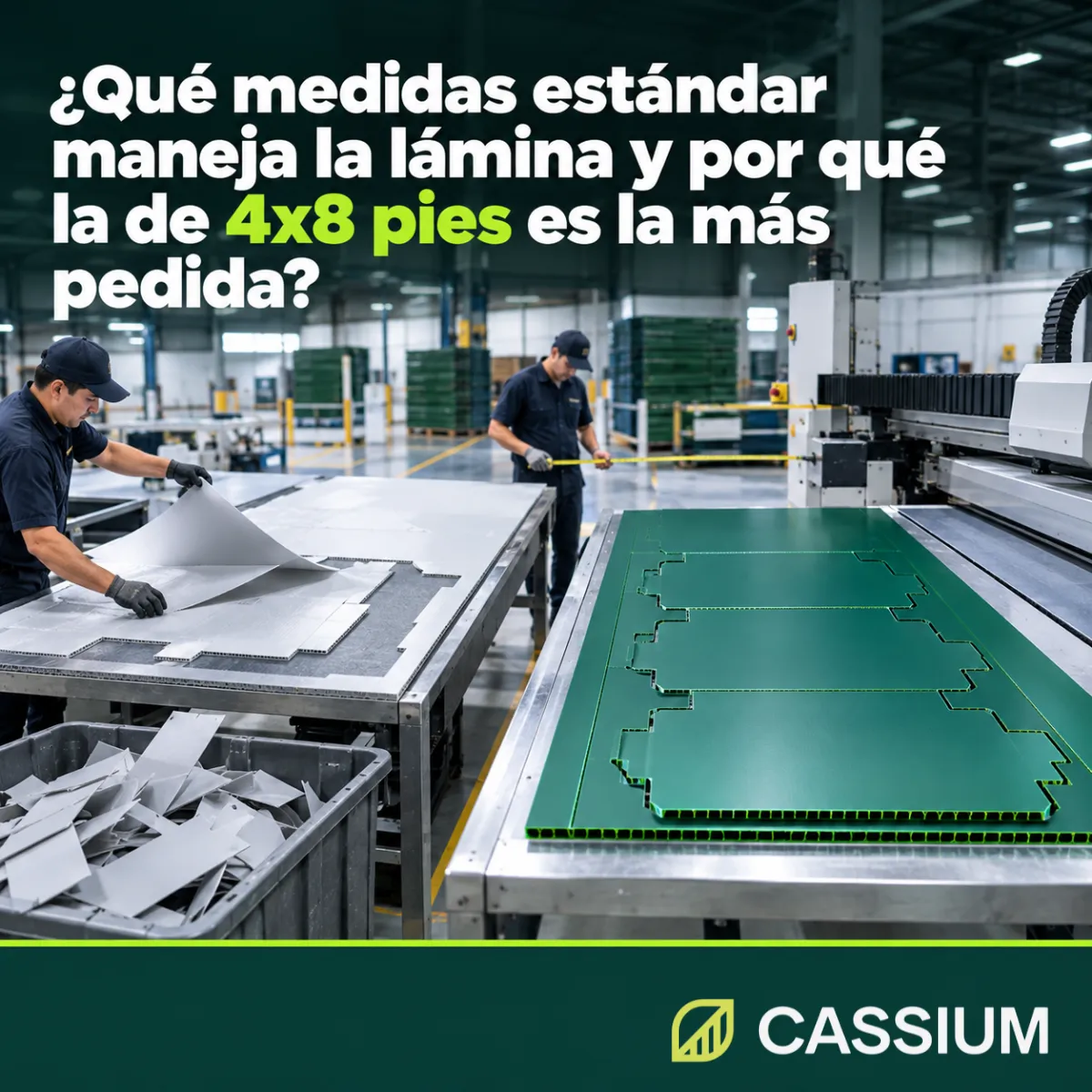
A manufacturer with its own extrusion works differently. Sheet leaves the line as a continuous web, and the sheet size is decided at the end of the process, when the web is trimmed and cut. For us, the 1.22 by 2.44 meter sheet is the size we produce on a regular basis; any other size is simply a different cutting instruction.
The cost of fitting the part to the sheet: joints, scrap and in-plant trimming
When the part is adapted to the sheet, three costs appear that rarely get added up together. The first is the joint: staples, tape or rivets that add labor and create a weak point that opens up under transport vibration. The second is scrap, because a part that nests poorly on the sheet leaves strips nobody uses. The third is trimming in your plant, which ties up a saw, an operator and line time. In the opening case, the joint was the most expensive of the three.
How a custom size is made from extrusion onward
The length and the width of the sheet are set at different stages of the process. Knowing where each one comes from helps you order a size that can be made without surprises.
Width comes from trimming and length comes from cutting
After the calibrator and the cooling stage, the sheet web goes through edge trimming, where its edges are cut off to leave the exact sheet width. Further down the line, a blade cuts the web crosswise every time the programmed length advances. Changing the sheet size means adjusting those two operations, without touching the formulation or the gauge.
That is why a custom size leaves our plant already cut, ready to go into your die cutter or your assembly line.
The flute runs in the direction the web travels
In an extruded sheet, the ribs that join the two faces run in the direction the web travels. This means the side of the sheet that runs along the flute is set by the crosswise cut, and the side that crosses the flute is set by the width of the web.
This detail matters when your part has a required flute direction. If a divider must have the flute along its long side to carry the load, that side can grow with the cut. If your part needs the flute parallel to its short side, the long side is limited by the width of the web, and it is best to review it with us before you finalize the design.
Process limits: what the line sets and what handling sets
We make any size within the limits of our process. The maximum width depends on the web our extrusion line produces, and the practical length depends on how a very long sheet is handled, stacked and shipped. If your part comes close to either limit, share its dimensions with us in your first request and we will confirm whether it fits on a single sheet.
What changes in your order when you move away from the standard size
A custom size keeps everything that defines the sheet: polypropylene, double wall, gauge, grammage and variant. What changes is how your order is scheduled, packed and received.
Minimum order by variant and gauge
The standard sheet is produced on a regular basis, so it can be supplied in small quantities. A custom size requires scheduling a run with a specific cut, and the minimum varies with the variant and gauge you order. Tell us your estimated monthly consumption and we will guide you; in most cases we can adjust production to your operation.
Lead time: a run that gets scheduled
The standard size ships without an extra cutting step. A special size goes into the production schedule, and its lead time can vary with the order, the gauge and the variant. If your project has a start date, include it in your request.
Weight per sheet, sheets per pallet and receiving
The weight of a sheet is calculated from its area and its grammage. A 2.60 by 1.20 meter sheet has 3.12 square meters; at 4 mm and 650 g/m², it weighs about two kilograms. With that figure you can plan how many sheets fit on a pallet, how much each pallet weighs for your forklift and how much rack space you need.
A special size also changes the number of sheets per pallet. Ask how your order will be packed before you schedule receiving.
Gauges, grammages and colors outside the standard table
A custom size can be combined with everything we make. You can order it in any gauge from 2 to 6 mm, in grammage combinations that are not on the standard table, such as 3.5 mm sheet, in the color your operation or your brand needs and in any of our variants: Standard, UV Retardant, ESD or Agave. If the sheet will be printed, ask for corona treatment in your quote as well.
When a custom size pays off and when cutting the standard sheet does
There are orders where the standard sheet is still the best buy. The decision comes down to a simple calculation.
Cost per usable part: the calculation that decides
Compare how much sheet you pay for per finished part in each scenario. With the standard sheet, the 2.60 by 0.40 meter divider from the opening is built from two 1.30 meter pieces; each sheet yields three pieces, that is, one and a half dividers for every 2.98 square meters, almost two square meters per divider. A custom 2.60 by 1.20 meter sheet yields three complete dividers from 3.12 square meters, just over one square meter per divider.
In that case, the special size cuts the sheet you buy per part almost in half, and it also eliminates the joint, the assembly labor and the risk of the divider coming apart. When the savings in material and assembly exceed the price difference and the run minimum, the custom size wins.
When the standard sheet still wins
The standard sheet makes sense when your part already nests well on it, with little scrap after accounting for your tooling margins. It also makes sense for prototypes and for small or urgent orders, because it ships without scheduling a run. A common practice is to validate the part on standard sheet and move to a custom size once the design and the volume are confirmed.
How to order a custom size so your part does not arrive rotated
A poorly described special size can arrive with the flute running the wrong way.
The data that define a special size
Write the length and width of the sheet in millimeters and state which of the two sides must run along the flute. Make clear whether the sheet is the final part or whether your die will cut parts out of it, because in that case the sheet must include the edge margins your tooling needs. If your process requires a specific tolerance or a precise squareness, note it next to the dimensions. Add the gauge, grammage, variant, color and volume per order, and your request is ready to be quoted in a single round.
A sample before you commit to volume
We send you a free sample of the variant and gauge you are interested in, so your team can validate folding and cutting in its own process before confirming the size and the volume.
At Cassium we extrude corrugated polypropylene sheet from 2 to 6 mm at our 5,000 m² plant in Santa Catarina, Nuevo León, under our ISO 9001:2015 quality management system. We produce the standard 1.22 by 2.44 meter sheet and any other size to order, cut right at extrusion, so your part comes out of a single sheet with no trimming in your plant.
If your part was born split in two, or your team trims every sheet before using it, it is worth asking about the exact size before your next purchase. At Cassium we make 2 to 6 mm sheet in the standard size and in the length, width and color your process needs. Find your starting gauge, grammage and variant with our Recommender.