
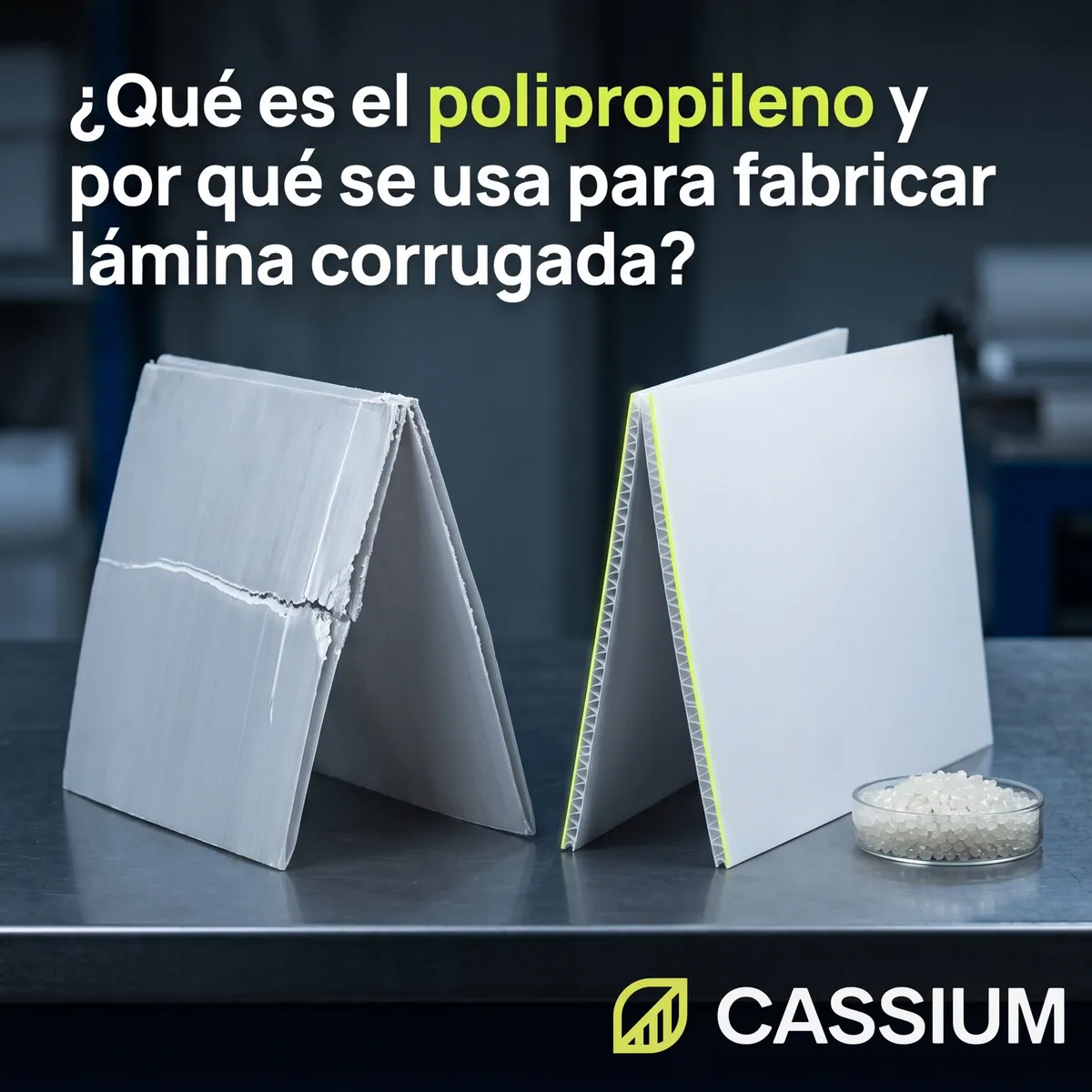
Polypropylene is a lightweight thermoplastic, resistant to chemicals and moisture, that withstands thousands of folds without breaking and is extruded in a single piece with a corrugated structure. That combination is what lets a sheet endure washing, impacts and use cycles where other materials fail.
What polypropylene is and where it comes from
Polypropylene (PP) is a thermoplastic polymer obtained from propylene, a derivative of oil and natural gas. Thermoplastic means it softens with heat, takes shape and recovers its rigidity as it cools, and that this cycle can be repeated: that is why it can be extruded, molded, welded and, at the end of its service life, melted again. It is one of the most widely produced plastics in the world and the dominant one in industrial packaging, auto parts, containers and, with a corrugated structure, in sheet.
Homopolymer and copolymer: two families with different behavior
Not all polypropylene is the same. Homopolymer is stiffer and tolerates temperature better, but it becomes brittle in the cold and under impact. Copolymer incorporates a fraction of ethylene into the chain and gains impact resistance and flexibility, especially in the cold, in exchange for some stiffness. Industrial corrugated sheet is made with the formulation that balances stiffness and toughness for the use it will have, and that balance is a manufacturing decision, not an accident. When the sheet cracks at the fold, it is almost always a formulation too stiff for that application.
The properties that explain why it is used in sheet
The choice of polypropylene for corrugated sheet comes down to five properties that combine in the same material and that no other common plastic brings together at that cost.
Low density: more sheet per kilo
Polypropylene is one of the lightest plastics there is: it floats on water. For a sheet that means less weight per square meter at the same stiffness, which translates into packaging that weighs less, cheaper freight and operators who move dividers without strain. A polypropylene sheet divider weighs a fraction of its equivalent in wood or in solid sheet.
Chemical and moisture resistance
Polypropylene does not absorb water and resists acids, bases, detergents, oils and most industrial solvents. That is why a sheet tray is washed with hot water and detergent without swelling or warping, and why packaging that gets wet in the truck arrives in the same condition it left in. Cardboard absorbs moisture and loses strength; wood swells; polypropylene does not change.
Fatigue resistance: the living hinge
There is one property of polypropylene that packaging engineers value especially: it can be folded thousands of times along the same line without breaking. It is called a living hinge and it is what allows a sheet box to fold and unfold on every return cycle, or a divider to open and close for years. Other plastics whiten and fracture at the fold after a few repetitions.
Service temperature range
Polypropylene keeps its properties across the temperature range of almost any industrial operation, from the ambient of a warehouse to a hot-water wash. Its upper limit is above what other packaging plastics withstand, and at its lower limit the copolymer keeps the toughness the homopolymer loses. For cold storage or outdoor use, the formulation and the additives are chosen at extrusion.
Weldable and convertible: what makes finished product possible
As a thermoplastic, polypropylene bonds to itself with heat: two pieces of sheet are welded by ultrasound or hot air without adhesive, and the joint is the same material as the pieces. That makes it possible to build boxes, trays and dividers with welded partitions that do not come apart with washing or with cycles. It also cuts with a blade or die without splintering, scores for folding and accepts printing with the right inks. A material that can be converted with those four operations in the same plant is what makes custom finished product possible.
Recyclable and reusable as raw material
As a thermoplastic, polypropylene is recovered at the end of its service life: it is ground, melted and fed back into the process, identified with recycling code number 5. A sheet that has completed its use cycles becomes raw material instead of waste, which weighs more and more in the environmental audits of end customers.
Why polypropylene and the corrugated structure work well together
Corrugated sheet is made by extrusion: molten polypropylene passes through a die that gives it, in a single continuous piece, two flat faces joined by internal ribs. That demands a material that flows stably, solidifies with uniform speed and does not deform as it cools. Polypropylene meets all three conditions, and that is why a well-extruded sheet comes out with an even gauge from edge to edge and without internal stresses that would twist it later.
What changes when the material is not polypropylene
The market carries corrugated sheets made of other polymers, and polypropylene sheets with high loads of filler or of recyclate of unknown origin. They look the same and cost less. The difference shows in use: lower impact resistance, folds that crack, deformation with heat, moisture absorption in mineral fillers and property variation between lots. The opening scenario almost always has this explanation.
Additives: what is added at extrusion
Base polypropylene is complemented with additives incorporated at extrusion for specific applications: UV stabilizers for outdoor use, antistatic or dissipative agents for electronics, colorants for identification by line or by customer, and retardants when the application demands it. An additive applied afterwards, on the surface, wears off; one that goes into the mass accompanies the sheet for its whole life.
What to ask before buying corrugated sheet
The lesson of the buyer in the opening fits into four questions: what polymer the sheet is made of and in what proportion of virgin material; whether it is homopolymer or copolymer and what application it was formulated for; what additives it carries in the mass; and whether the manufacturer provides a technical data sheet and a physical sample to test on your own line before committing volume. At Cassium we extrude the sheet at our Monterrey plant with polypropylene formulated by application, and we deliver a sample with a technical data sheet per gauge and variant, with processes certified under ISO 9001.
The technical data sheet is the document that turns those four questions into a specification. It should declare the polymer and its type, the gauge with its grammage range, the recommended service temperature, the additives incorporated and the storage conditions. With it, the purchase order stops saying "four-millimeter sheet" and starts describing a concrete material that the next lot has to match. Without it, every delivery is a bet that gets settled on the line.
If a new sheet cracked at the fold or warped with washing, the problem started in the material, not in your process. At Cassium we manufacture corrugated polypropylene sheet with our own extrusion and deliver a physical sample with a technical data sheet before you commit volume. Review gauges, variants and process at https://cassium.com.mx/en